
A Likely Spirit
Flip to page 24 of Ashcroft’s Railway Directory for 1866, and you’ll see that the roadmaster for the Boston & Lowell and Nashua & Lowell Railroad is listed as J. B. Eaton. The entry also shows that Eaton’s residence was Nashua, New Hampshire, so it’s not surprising that that’s where he was buried. Regarding his death, a year after appearing in the directory — on October 10th, specifically — Eaton was killed on the job while down near Woburn, Massachusetts.
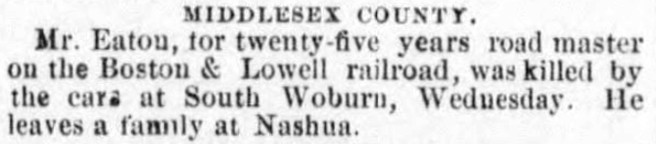
Another notice clarifies that Eaton died by “slipping from a platform on to the track,” where he was presumably hit by passing cars. Perhaps the best explanation of how a seasoned railroad employee can fall prey to such a work accident appeared a couple of days later in Washington D.C.’s Evening Star. It seems Eaton might have sneezed or coughed, causing his false teeth to fly out of his mouth. At least, “a set of false teeth were found in the clenched hand of the deceased, and it is highly probably the fall was principally owing to a sudden movement to recover them….”
The death notice shown above specifies “South Woburn,” and that’s now called Winchester. But the name change happened in 1849, so it’s odd that the 1867 notice still says “South Woburn.” Luckily, another notice of his death specifies “Woburn W. Place,” which I take to mean “Woburn Watering Place,” (elsewhere noted as “Woburn Water’g pl.”). I’ll explain why this is important in a moment.
If nothing else, this provides a distinctive backstory to a railroad haunting that was chronicled in newspapers in early 1870. But Eaton’s spirit isn’t the only candidate to explain the haunting. A list of accidents on the Boston & Lowell line appears in an 1867 report on railroad corporations, and Eaton’s death is accompanied by another possibility: “August 12. — Sumner Clark, while walking on the track near East Woburn, was struck by a train, receiving injuries which caused his death.” However, Eaton’s professional dedication to railroad safety — and the probability that his accident occurred at Woburn Watering Place — make him a better fit for the specific manifestations of the haunting.
The 1870 Railroad Haunting
What I mean becomes clearer in an 1870 report that apparently began in Boston, Massachusetts, but that travelled as far as newspapers in the UK and London’s The Spiritual Magazine.
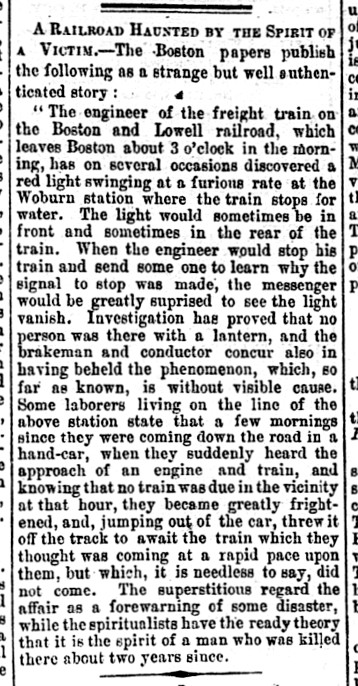
It’s an especially weird case in that there are two distinctive manifestations reported: the sighting of an inexplicable swinging red light and the sound of a train that never appears. It’s also interesting that two theories of the haunting are posited: a sign of future danger, or a spirit of past tragedy. I haven’t explored the forward-looking possibility, and Eaton’s death is the best evidence I’ve found to support the ghost theory.
Finding the Station Today
This case required me to sort out a tangle of names and name-changes. According to an 1867 Boston & Lowell schedule, a northbound passenger can leave Boston and, after Winchester, get off at 1) East Woburn, 2) “Woburn water’g pl.,” or 3) North Woburn, the train continuing on to Wilmington. There’s also an option to take the Woburn branch and, after Winchester, detrain at 1) Richardson’s, 2) Horn Pond, or 3) Woburn Centre. However, a circa-1890 map (see below) shows new names for the main-branch stops between Winchester and Wilmington: Walnut Hill and then E. Woburn. (I have a hunch that the latter was a mistake: “E Woburn” should have been marked as North Woburn.) And here the Woburn branch lets you stop at Cross Street or Woburn Highlands before “WOBURN.”
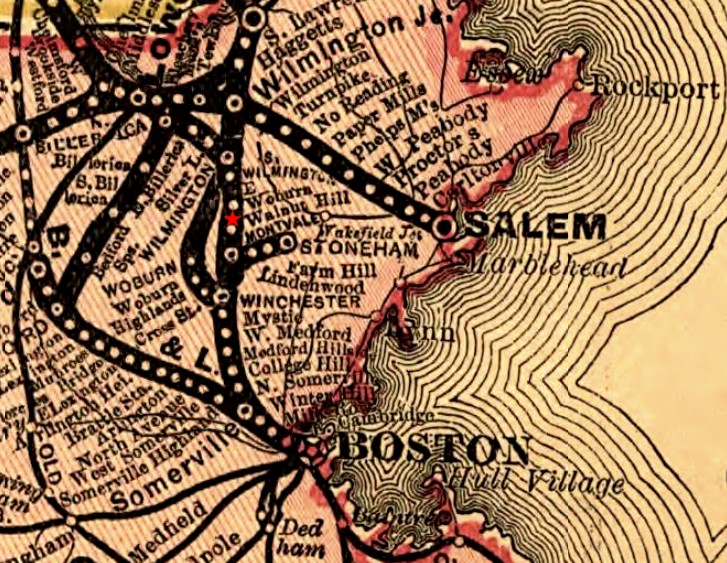
Now, the ghost report is very vague about where the phantom train was heard. I think that might be a lost cause. We can do much better with the spectral red light, though, because it was observed “where the train stops for water.” There’s that stop marked as such on the 1867 schedule, and according to a 1918 history of the Boston & Lowell, “For many years the station now called Walnut Hill was known as Woburn Watering Station.” Walnut Hill is marked on the 1890 map, and it remains an eastern neighborhood of Woburn today. An interested ghost hunter might use this location to carefully explore the tracks that still run — and are still used — between Winchester and Wilmington. They run parallel to and east of Wildwood Avenue.
As I say, this is very likely where roadmaster James Bradford Eaton lost his life while scrambling to retrieve his false teeth. This is very likely where, a bit more than two years later, a ghostly red light was reported to swing “at a furious rate.” Does this phenomenon — or the sound of a phantom train — still linger? Please let us know in the comments if you do any investigation. And if you’re disappointed there, consider exploring nearby Horn Pond, reputed to be the site of a variety of paranormal manifestations.
Discover more “Railroad Hauntings You Can Still Visit” at the page for
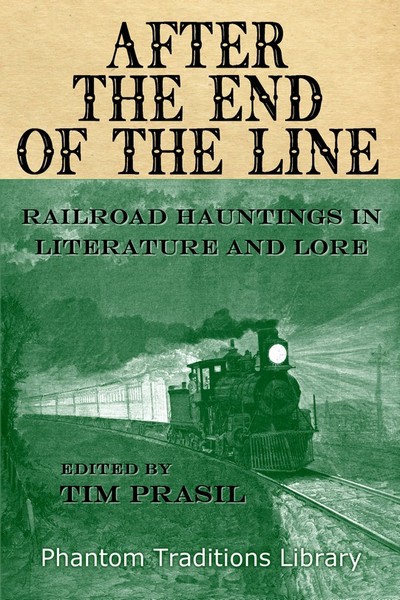
After the End of the Line: Railroad Hauntings in Literature and Lore.
 BROM BONES BOOKS