A Setting for the Supernatural
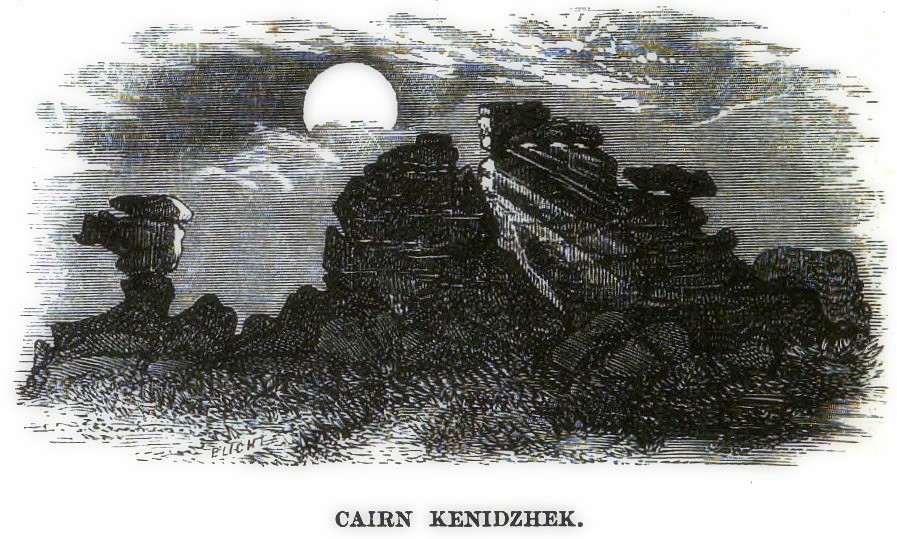
The grassy grounds surrounding Carn Kenidjack, in Cornwall, is a fabled and forbidding landscape. Allegedly, strange sounds rise from the rock formation at night, accounting for its original name Cairn Kenidzhek, which means “hooting cairn.” In 1887, Margaret Ann Courtney described the place this way:
It enjoys a very bad reputation as the haunt of witches. Close under it lies a barren stretch of moorland, the "Gump," over it the devil hunts at night poor lost souls.... It is often the scene of demon fights, when one holds the lanthorn to give the others light, and is also a great resort of the pixies. Woe to the unhappy person who may be there after nightfall: they will lead him round and round, and he may be hours before he manages to get out of the place away from his tormentors. Here more than once some fortunate persons have seen 'the small people' too, at their revels....
What about Witches?
Beyond saying witches lurk near Carn Kenidjack, Courtney does not provide any specifics. Sixty-six years before her, John Thomas Blight tried to convey the mood of the area by saying that “Macbeth’s witches might have danced on such a spot.” But that’s as witchy as he gets.
For an individualized tale of a witch there, we turn to Robert Hunt’s Popular Romances of the West of England (1865). It’s short enough for me to quote in full:
On the tract called the "Gump," near Kenidzhek, is a beautiful well of clear water, not far from which was a miner's cot, in which dwelt two miners with their sister. They told her never to go to the well after daylight; they would fetch the water for her. However, on one Saturday night she had forgotten to get in a supply for the morrow, so she went off to the well. Passing by a gap in a broken down hedge (called a gurgo) near the well, she saw an old woman sitting down, wrapped in a red shawl; she asked her what she did there at that time of night, but received no reply; she thought this rather strange, but plunged her pitcher in the well; when she drew it up, though a perfectly sound vessel, it contained no water; she tried again and again, and, though she saw the water rushing in at the mouth of the pitcher, it was sure to be empty when lifted out. She then became rather frightened; spoke again to the old woman, but receiving no answer, hastened away, and came in great alarm to her brothers. They told her that it was on account of this old woman they did not wish her to go to the well at night. What she saw was the ghost of old Moll, a witch who had been a great terror to the people in her lifetime, and had laid many fearful spells on them. They said they saw her sitting in the gap by the wall every night when going to bed.
Red Shawls and Witches Who Linger
Two elements of this legend grabbed my attention: the red shawl and the fact that the witch is a ghost. Working on one of my other projects a while back, I wrote about a 1905 newspaper article describing Alabama railroad workers being terrified by the ghost of “a frightful looking hag with a large red shawl wrapped around her head.” In that post, I refer to this Cornish legend along with one from Ireland and another from Wales, all of which signal the danger of a witch by putting her in a red shawl. My hunch is that those Alabama workers had inherited this folklore motif from Celtic ancestors. (If the pairing of witches and red shawls is found elsewhere, I’d love to hear about it!)
As I delve further into witch legends, from time to time, I stumble upon a tale of a witch whose power transcends death and whose spirit is really the star of the show. The spectral witch in Alabama appears to be limited to materializing and sending train mechanics fleeing in confusion. The Kenidjack witch’s magic seems to have weakened since death, reducing her to pulling pranks at the well. Since Old Moll doesn’t seem able to do much harm now that she’s dead — not like in her glory days — perhaps she simply wants to be remembered. The most impressive ghostly witch I know about is Tennessee’s Bell Witch, a legend born in the early 1800s. From a later perspective, this case smacks of poltergeist activity. The folks involved didn’t have the word “poltergeist” in their vocabulary, though, so they dubbed the spirit a “witch,” one possibly conjured by Kate Batts.
Folktale Fashioned into Fairy Tale
My research led to a story titled “The Magic Pail,” which appears in Enys Tregarthen’s 1905 collection The Piskey-Purse: Legends and Tales of North Cornwall. Aimed at children, the book contains what we can confidently call fairy tales, since Tregarthen points out that they feature “Piskey and other fairy folk” (p. ix). Two pages later, though, she uses the term “folklore tales,” perhaps to inject a told-at-the-fireside-in-olden-days charm to them. At the same time, “The Magic Pail” is 51 pages of detail and dialogue, which implies it’s far removed from quaintly creepy stories heard at Cornish hearths. It might be a very loose adaption of the legend Hunt transcribed. It might simply have been inspired by that legend and others like it. It might be something entirely different.
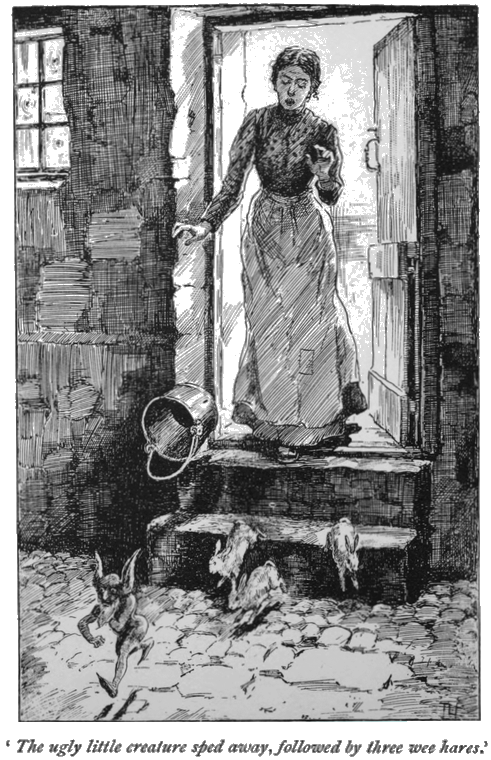
Nonetheless, Hunt’s and Tregarthen’s two narratives share basic building blocks: Carn Kenidjack is the setting, a miner is an important character, a pail is a key prop, and there’s magic and mystery. Beyond that, the stories are pretty different. Hunt’s doesn’t seem to teach a clear moral for its audience, depending instead on stirring a moment of wonderment. Tregarthen’s is more of a King Midas/Monkey’s Paw/be-careful-what-you-wish-for thing, the pail granting wishes that turn out badly in one way or another. It’s a well-crafted tale, if a bit long, and certainly one that illustrates how Carn Kenidjack radiates a sensation of strangeness — and stories about the same.
 BROM BONES BOOKS