Of Course, Legends Evolve
Do an Internet search for “Hannah Cranna,” the main figure in a witch legend rooted in the Stepney district of Monroe, Connecticut. You’ll probably find out that:
- Hannah was a real person, who was born in 1783 and who died in the winter of 1859/60.
- She was married to Captain Joseph Hovey, who died under mysterious circumstances.
- Those years and the marriage are confirmed by Hannah’s headstone (shown below) in the Gregory’s Four Corners Burial Ground.

Interestingly, these points disagree with the earliest transcription of the legend I’ve been able to find. It’s a three-part, anonymous article published in The Newtown Bee on the 7th, 14th, and 21st of December, 1900. On the 28th, The Bee published a sort of letter-to-the-editor from a reader who adds more to the article’s many tales told about Hannah’s witchy exploits.
If only to stir a cauldron of confusion, I’ll take a look at the discrepancies between what I’ve read on the Internet and what’s in this 1900 transcription. I won’t attempt to suggest that one version of the legend is right or “righter” while the other is wrong or “wronger.” Legends simply don’t work that way. But maybe this will provide an insight into how these (more than) twice-told tales evolve over time, and how the Internet has given us something new to consider when it comes to sharing folklore.
Why Was Hannah Called “Cranna” and When Did She Live?
All by itself, that headstone is a bit of a head-scratcher. Is “Cranna” Hannah’s maiden name? At first glance, this seems reasonable. Cranna is a surname, after all, one probably derived from a Scottish term for a rocky or lofty place. In the first installment of The Bee article, though, the writer establishes that “Cranna” is Hannah’s married name, since her husband is identified as Silas Cranna. So what do we do with the headstone saying “wife of Captain Joseph Covey”? Well, according to the Damned Connecticut website, the woman buried there “apparently picked up the nickname Hannah Cranna while she was still alive.” The New England Ghoul adds that it was meant to insinuate that Hannah might have pushed her husband off a cliff, i.e., a rocky and lofty place. Interesting! Does dubbing Hannah this name suggest Monroe had a significant Scottish population? More importantly, would such a nasty nickname be carved into a headstone? Wouldn’t there be, say, quotation marks around it or something else to imply this was what Hannah was called informally, if not behind her back? That headstone raises more questions than it offers answers.
Let’s move on. There’s also a discrepancy in when Hannah lived. After an introduction, The Bee writer sets the stage for the legend proper:
Many years ago, so many that only one or two of the oldest inhabitants ever saw her, in the house on the hill lived Hannah Cranna. . . .
If Hannah died 40 years before the article was printed, as that headstone indicates, there probably would be more than “one or two” locals old enough to have seen her. While life expectancy was indeed shorter in the 1800s, that’s an average age of dying, one lowered by the many things that spelled death, especially infant mortality. If one managed to avoid those many deadly things, people lived about as long as they often do now, and it was far from unheard of for some folks in the 1800s to live into their 70s, their 80s, even their 90s. The woman whose headstone is shown above, for example, lived to about 76. More than a century before that, Ben Franklin’s parents survived well into their 80s. Human DNA hasn’t changed that much in a few centuries, after all. It’s just that we’re generally lots better at making it to “old age,” raising the average life expectancy. With this in mind, The Bee’s Hannah seems to be a generation or two older than that the Internet’s Hannah.
The Death of Hannah’s Husband
The website for the New England Historical Society also works on the premise that Hannah in the legend was the wife of Joseph Hovey and follows the dates on the headstone. It explains Hovey’s death this way: “No whisperings of witchcraft followed [Hannah] until her husband died suspiciously…. The townspeople of Monroe thought Hannah had cast a spell that confused Joseph Hovey enough to wander into an abyss. From then on she carried the nickname Hannah Cranna.”
The Bee writer, on the other hand, gives a less ambiguous story. It starts this way:
Silas Cranna was an inveterate tippler [meaning an alcoholic] and passed much of his time [drinking] at an inn that stood at the present site of Porter's blacksmith shop, near Stepney Depot.
Please permit me a quick digression. In 1900, there was a blacksmith named Porter who worked near the Stepney train depot. The notice below shows he wanted whoever pilfered his saw to return it, if you please!
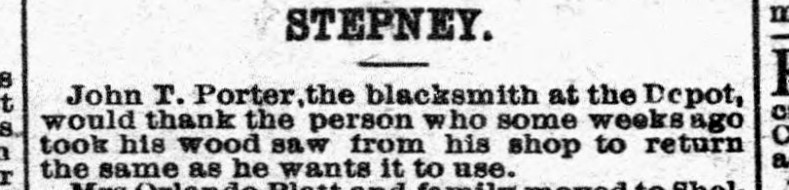
Now, this doesn’t prove that an inn was there previously or that someone named Silas Cranna frequented it. Mentioning the blacksmith might be nothing more than a way to add a dash of recognizable reality to an otherwise fabricated story (and it’s followed by references to other residents alive in 1900). Now, let’s get back to that story:
[Silas Cranna's] mode of life, to say the least, annoyed Hannah, and she ushered in her initiation to witchcraft by murdering him.... [Witnesses near a local cliff watched as] she seized him and dragged him toward the edge of the precipice. He struggled desperately but his virility being undoubtedly much weakened by his bucolic habits, he was no match for his enraged wife. She forced him, writhing and screaming for help, to the edge and deliberately thrust him over.... Silas Cranna never stirred again. He was dead.
Unlike the Internet version, the mystery surrounding what became of Hannah’s husband is set straight in The Bee version: Hannah committed mariticide up on Helvelyn crag.
There’s another problem, however. I can’t find evidence of a “Helvelyn crag” anywhere near Monroe. Was The Bee writer, in this case, changing the name to protect the innocent? Maybe “Helvelyn crag” was a pseudonym for what the CT Insider identifies as the spot where the Hoveys allegedly lived: “Cragley Hill, close to present-day Cutler’s Farm Road.” Much more likely, it’s an alternate spelling of “Haviland Hill,” which Monroe historian Edward Nichols Coffey says was the traditional name for Bug Hill Road.
The Many Agreements Between The Bee and the Internet
Coffey’s out-of-print book, A Glimpse of Old Monroe, includes a discussion of the Hannah Cranna legend. It was published in 1974, and so it acts as a nice “halfway point” between The Bee and the Internet versions. (Please tell me if you know where I can find a copy that isn’t too expensive.) Scroll down to the Hannah Cranna section in this online article from The Monroe Sun, and you’ll see it leans heavily on Coffey’s version. Given what’s there about “Cranna” being a nickname and “Hovey” being Hannah’s real one, I suspect a lot of the Internet accounts can be traced back to Coffey’s book.
But a lot of the Internet lore fits nicely with The Bee article, too, meaning some of what’s being said now has been said for well over a century. For instance, there’s an anecdote about Hannah striking back at a couple of farmers who pooh-poohed the authenticity of her conjuring powers. She cast a spell that halted their oxen from carrying a cartload of hay. The Bee article identifies the farmers as Theodore Beach and Isaac Nichols. A site called Paranormal Catalog leaves them nameless, but it’s the same illustration of Hannah’s tit-for-tat approach to witchcraft.
In addition, Hannah’s beloved rooster, Old Boreas, has been part of the legend all along. The bird crowed reliably every midnight instead of every morning, and when he died, Hannah gave him a starlight burial “exactly in the center of her garden,” according to The Bee article — and “in the exact center of her garden,” according to Cemetery Insights and Beyond. In other words, some of the legend continues to be told very much as it was in 1900. And Old Boreas’s star still shines!
The account of how Hannah meddled with her own funeral has persisted across the decades, too. She left instructions that her coffin should be transported all the way to the cemetery by pallbearers, not by a cart or some other vehicle pulled by horse or oxen. The Bee writer describes Hannah threatening the villagers:
"Obey my wishes strictly if you would avoid trouble and vexation of spirit, for remember, even after I am no more there will be that which I shall leave behind that will see that my wishes in this matter are respected and fulfilled."
It being the dead of winter, though, the villagers disobeyed. They tried to drag the coffin on a sled behind some oxen, but it slipped off time and again, and even chains wouldn’t hold the bewitched box in place. At times, the coffin seemed to move of its own volition!
It was, therefore, eventually decided to return with the body to the house and to start again from thence at an hour before sunset, carrying the remains of the witch as she had dictated, thus fulfilling in every detail her last instructions....
This parable in respecting final wishes — along with several other yarns about Hannah found in The Bee transcription — persist as standard elements of the Internet renditions of the legend. And that’s pretty cool.
Where Does This Leave Us?
Much as Hannah Cranna’s coffin shifted and slipped from that sled, folklore is unsteady. It wiggles and wobbles over time. Readers interested in spooky legends about witches, ghosts, lake monsters, or what have you should keep in mind that what they find on the Internet is often just one version of the story — almost certainly not the only one. At the same time, the Internet has made it easy to see what was being said long before the Internet! Dig deep. Gage how long a particular legend has been around. Spot the discrepancies. Appreciate the consistencies.
Only then can one enjoy the ways that legends evolve and, by evolving, endure.
 BROM BONES BOOKS
2 thoughts on “The Hannah Cranna Legend: A Transcription from 1900 Versus the Internet Version”