First Impressions on Readers of English
While many readers of English might have been introduced to Baba Yaga by George Borrow in 1862, W.R.S. Ralston’s influential Russian Folk-Tales (1873) delves much further into the figure. However, Ralston describes Baba Yaga as “a species of witch” (p. 9), and his sample tales about her — such as “Marya Morevna” or “Vasilissa the Fair” — emphasize her more sinister side.
Perhaps to counterbalance Ralston, Jeremiah Curtin revealed more of Baba Yaga’s kinder side in Myths and Folk-Tales of the Russians, Western Slavs, and Magyars (1890). In some of the tales translated there (probably by Curtin himself, though I don’t have confirmation of this), Baba Yaga has a very minor role. At times, she is a trio of sisters, each referred to as “a Baba Yaga.” Given this, Curtin illustrates the flexibility in this folkloric character more than Ralston. I’ll focus here on the tales from the later work that especially present Baba Yaga acting as a character who helps rather than threatens the protagonists.
“The Feather of Bright Finist the Falcon”
Bright Finist, the title character in this tale, has the enviable ability to toggle between human to falcon forms. He falls in love with a maiden, but her two jealous sisters drive the birdman away. The unnamed maiden embarks on a quest to find him, and along the way she is assisted by three sisters: the Baba Yagas. We recognize that this is the same basic character as in the Ralston collection because, in each case, the maiden comes upon a “hut on hen’s legs, and it turns without ceasing.” Inside, she finds a woman with a gigantic nose who’s lying from one corner of the hut to the other. Baba Yaga’s usual pestle-controlled flying mortar is missing, though, and so are the bones and skulls of victims with which she decorates her fence. She’s still a bit creepy, I guess, but she turns out to be very helpful.
One after the other, the Baba Yagas provide the maiden with a meal, a night’s rest, and the knowledge that Bright Finist is to marry another woman. They also give the maiden the implements needed to thwart her competition, which is exactly what happens. In fact, by the end, Bright Finist has married that other woman. Not to worry, though! It is decided that his legally wedded wife is “to hang on a gate,” where the local officials shoot her. Folktale Justice doesn’t shilly-shally!
A version of this story appears in Russian Wonder Tales (1912), translated by Post Wheeler and illustrated by the great Ivan Bilibin. However, Wheeler doesn’t identify Baba Yaga by name.
“Water of Youth, Water of Life, and Water of Death”
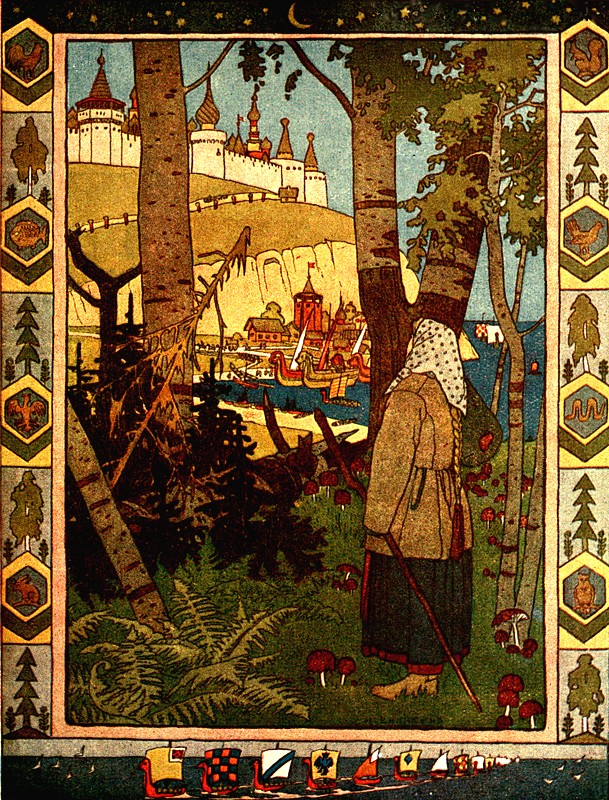
This story is a weird one! In a nutshell, the Tsar hears that there’s a beautiful maiden “from whose hands and feet water was flowing, and whoever would drink that water would become thirty years younger.” (Did I mention it’s weird?) Two of the Tsar’s sons fail to find the maiden, scared off by warnings of being dismembered that come first from “a gray old man” and then from Baba Yaga. Beyond the name and the nickname “boneleg,” this Baba Yaga doesn’t appear with any of the usual indicators: no spinning hut on chicken legs, no huge nose, etc. The Tsar’s third son, Ivan, next tries to find the magic maiden, and he also comes upon “Baba Yaga, boneleg.” If this is the same one his brother encountered, we don’t know, but this time, there is mention of “a cabin on hen’s feet.” As were his brothers, Ivan is warned against pursuing his goal. He’s determined, though, and the remainder of the adventure involves his finding ways around the dismemberments foretold by Baba Yaga. She has a very small role, and it’s limited to cautioning the protagonist about dangers ahead. Poor Ivan doesn’t even get a meal or a night’s rest out of the deal. Nonetheless, Baba Yaga is shown to be making a bit of an effort to guide him on for his quest. At least, she gets points for not eating Ivan.
“The Enchanted Princess”
It’s hard to decide if there are two Baba Yagas or only one in the previous tale, but in this one, there are definitely three. There’s no mention of the hut, the nose, the flying mortar and pestle, the skull-lined fence — all the props and set pieces that, in my mind, help to make Baba Yaga a consistent character. Of course, folklore doesn’t really lend itself to such continuity. It’s not Star Trek. I guess the debates over “keeping with canon” don’t make much sense here.
Another romance. A soldier meets a talking bear, who explains she’s really an enchanted princess. He breaks the spell, they fall in love, and the soldier then falls prey to the same “unclean” group who cursed the princess. (I don’t know what’s implied by “unclean,” but it makes me uncomfortable.) One thing leads to another, and the soldier becomes “caught up by a boisterous whirlwind and borne away from her eyes.” Another quest. The soldier hopes to make his way home and, on the way, meets the first Baba Yaga, who is described as “bone-leg, old and toothless.” She guides him to her sister — and then the second Baba Yaga guides him to a third. This third Baba Yaga does more than help. She saves the day by commanding the winds to locate the princess and carry the soldier back to her.
As I say, none of the usual indicators of Baba Yaga are in this tale, but Baba Yaga does have the power to control natural elements. In one of the best known of her tales, which Ralston titles “Vasilissa the Fair,” Baba Yaga reveals that the Day, the Sun, and the Night “are all trusted servants of mine.” There, though, she just seems to be showing off. In “The Enchanted Princess,” she uses this power for the good of the protagonist.
The more I explore Baba Yaga, the more I become enchanted by her ability to take many forms. Indeed, she’s an enchantress, so I guess this was her plan all along.
 BROM BONES BOOKS