
A Wide-Spread Report
In late 1893, news of an apparition materializing near Sittingbourne Station in southeast England spread far and wide. The report appears to have originated in the Daily Telegraph, but it quickly spread to several other British newspapers, as far away as Australia, and even into journals aimed at those interested in the paranormal or in railroads.

As far as these railroad haunting articles go, this one seems a bit sketchy. The article suggests that there was only one witness, who encountered the specter only once. I’ve read enough of these reports to know there’s nothing at all unique about the driver thinking “he had run over [a] person . . . but no one was to be found” while also suspecting “the apparition foretells impending danger.” Those are both conventional elements of railroad ghostlore. So why did this case receive so much attention? Why did this skimpy evidence inspire residents to go out ghost hunting on those autumn nights?
Sittingbourne Station’s Deadly History
The answer might be buried in the fact that the “spot had proved fatal to one or two persons” within those local ghost hunters’ memories. In fact, Sittingbourne Station had been a deadly site for decades. Here’s what I found:
- 1861: On January 5, the Sun reported that a “fatal accident occurred” the previous day as a train approached Sittingbourne Station. The train threw a wheel and derailed, a passenger named Patterson becoming mangled in the wreckage. His injuries were so severe that he died a few hours afterward.
- 1862: On October 22, the Albion reported a similar accident. A mail train “ran off the line, near Sittingbourne Station, and killed the engine-driver.”
- 1878: The Glasgow Herald joined many British newspapers in reporting on an August 31 collision between two trains “on the London, Chatham, and Dover Railway, at Sittingbourne Station.” Two days after the tragedy, the journal explained that “five had been killed and about forty severely injured.”
- 1881: A paper called Brief News & Opinion reported on James Williams, a man who “was killed by being knocked down at a very dangerous level-crossing on the London, Chatham, and Dover Railway.” Interestingly, the article notes: “On account of numerous fatalities which have occurred at these crossings at Sittingbourne great indignation has been aroused….”
Given those “numerous fatalities” mentioned in 1881, I suspect there had been several other instances of horrible accidents around Sittingbourne Station by the time the 1893 ghost report gained so much attention. Reports of railroad-related fatalities were widespread during these decades, and this helps to explain why ghost reports involving grisly deaths probably struck a chord with a vast audience.
Finding the Haunted Site Today
While finding the station itself is easy, ghost hunters might have to visit a few possible locations to investigate what the 1893 ghost report describes as a level-crossing replaced by a foot-bridge. Luckily, the website of the ARCHI UK offers a very useful map of Milton-next-Sittingbourne along with an ingenious “Time Traveller Tool” that lets a user slide back and forth between a Victorian ordinance map and a modern one.
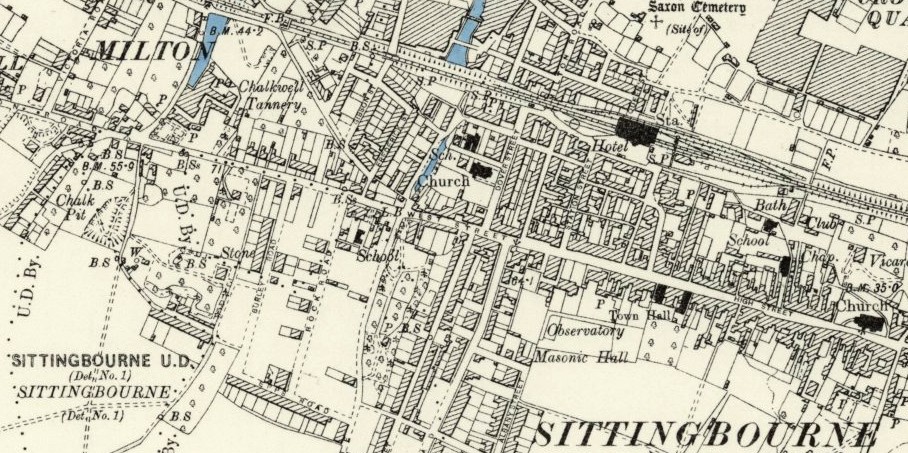
The bridge over the tracks that connects Jubilee Street to Hawthorn Road is a likely suspect for the haunted spot. However, I wouldn’t rule out what appear to be underpasses farther east: one connecting Redgrove Avenue to Laburnam Place, one at Milton Road, and one at Crown Quay Lane. The story about the haunting persists on various websites, such as the one for The Yorkshire Post and for The Paranormal Database. But does the ghost still walk? If you join those residents of 1893 in searching for answers, please let us know about your experience.
Discover more “Railroad Hauntings You Can Still Visit” at the page for
After the End of the Line: Railroad Hauntings in Literature and Lore.
 BROM BONES BOOKS