
A Phantom Train That Arrived Early
An article titled “Beyond Gower’s Land” appeared in the November 12, 1864, issue of the magazine Once a Week. It’s I.D. Fenton’s chronicle of a journey through Wales, and along the way, the traveler transcribes an anecdote heard in the South West region. Within context, this anecdote has the feel of folklore, a charming and quirky tale the locals tell. Whether or not the locals honestly believed it is another matter.
This colorful anecdote tells of a phantom locomotive, one keeping with the tradition of spectral manifestations warning of future events. Curiously, the ghost train arrived to signal the coming of trains themselves. The tale was weird enough to be excerpted and reprinted in newspapers across the UK, where it then took on at least a hint of being a trustworthy news report.

Presumably no record was made of the farmer’s prophetic experience — that “second-sighted” sign of trains one day tearing through the peaceful spot — before the railway was actually completed. One might wonder, then, if this tale is born of a nostalgic longing for the good old days. The unspoken moral of the story seems to be: I told you letting the railway come here was a bad idea! Didn’t I tell you?
But what if there is something more to it than that? Intriguingly, Fenton’s transcription provides enough clues to locate the real-life setting of the narrative. Some newspaper searching also gives us a pretty good timeframe for when that first corporeal train roared through the tunnel.
The Location of the Tunnel
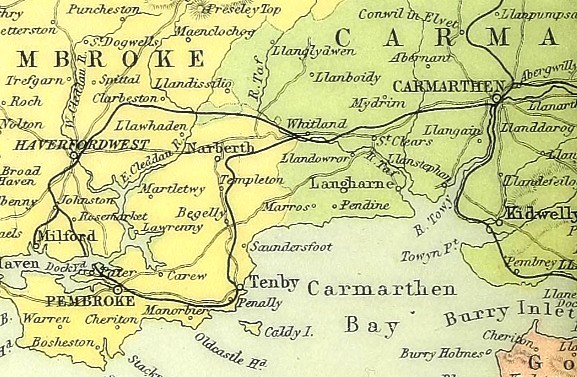
Fenton provides three landmarks that help us zero in on the location of the alleged encounter with a phantom train. First, there’s the River Tav (which I’ve also seen spelled “Tave,” “Taf” and “Taff.” The Welsh is “Afon Taf”). Apparently, this is not a safe place for trout, but it is for horses. Second, Fenton mentions Whitland Abbey, which is very helpful. The ruins of this structure lie northwest of the village of Whitland. Third, there’s the South Wales Railway tunnel, which is the most precise landmark in relation to the spectral/prophetic manifestation.
A bit of sloppy triangulation and a modern map reveal the tunnel is still there! (Look for the gap in the tracks in the southeast corner of that map.) Fenton is very helpful when it comes to pinning down where the prophetic experience allegedly occurred.
A Timeframe for the Anecdote
Determining when it occurred is trickier. Fenton only says “not many years ago,” which is hard to subtract from 1864. It’s better than “once upon a time,” I guess, but there’s still enough haze to add to the story’s feel of folklore. Ah ha! — perhaps Fenton had predicted the story would fall under the eye of a research addict 160 years later! I went searching to find out when that first physical train ran through the tunnel.
Thanks to the online newspaper archive of the Wales National Library, I found that the South Wales Railway noted by Fenton extended its line from Carmarthen west to Haverfordwest — running through the tunnel and stopping at Whitland — as 1853 came to a close. According to a reporter in that year’s December 30 issue of the Pembrokeshire Herald, the new route had opened some days earlier. Though “of momentous importance,” the event had its opposition:
That there should be persons who are sceptical as to the advantages which it is expected we shall derive from Railway communication is not to be wondered at, when we consider that there is a tendency in some minds to a morbid apprehension of any change of circumstances, habits, and modes of existence with which long custom has rendered them familiar. ... It is felt that to invade the lonely dells where simplicity, peace, and contentment dwelt in undisturbed repose ... with the hideous shriek of the iron King, as he whirls onwards with fearful rapidity to his destination, may indeed serve to increase our wealth, and enhance our commercial importance, but can never compensate for the calm tranquillity which it displaces.
Here, then, we see the perspective of that apprehensive farmer and of those spooked horses.
The reporter goes on to describe what westbound passengers will encounter. Most relevant to us is the passage about leaving “St. Clears, where the first Station is built, and after passing through a tunnel near Penycoed, it crosses the Tave by a timber bridge on Piles to the Whitland Station.” When locating the tunnel, the reporter appears to have mistaken a wood named Pen-y-coed with the Great Pale Wood, the two being about three or four miles apart. Still, it’s neat that the tunnel is mentioned at all, and a similar article printed in The Welshman on the same day refers to it, too.
Given these articles, we now know that the day foretold by the spectral locomotive arrived toward the very end of 1853. This is about a decade before Fenton’s record of the strange manifestation was published. We also know that the clamorous event was not welcomed by everyone. In other words, the anecdote might be a folktale — but there’s a fair amount of truth woven into it.
Would a Prophecy Leave Behind Traces?
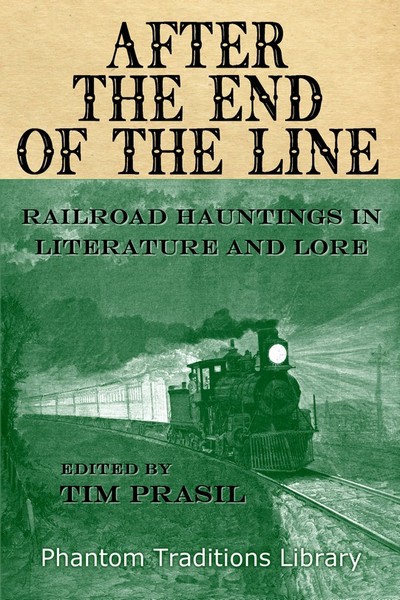
Your typical haunting comes afterward. Let me explain. Say there’s a terrible train accident. Ghosts of those killed are observed afterward. However, in some cases, the ghost appears before a tragic event, such as with the canwyll corff (or corpse candles) once well-known in parts of Wales. In After the End of the Line, an entire section titled “Danger Signals from Beyond” presents railroad-related narratives about ghostly warnings of things-to-come. This is what happened beside that South Wales Railway tunnel sometime before 1853.
Given this, is the area on either end of the tunnel worth investigating over a century-and-a-half after the fact? Could any residual energy be measured or paranormal activity intuited? Well, WalesOnline says yes, putting it as #25 on a list titled “Mysterious Wales: 34 weird and wonderful secret places to go in search of the supernatural.” Trains appear to still run through the site, though, so I advise extreme caution. Remember that the phantom locomotive appeared outside the tunnel. If you happen to go there for some ghost hunting — and/or some trout fishing — please let us know about your outing in the comments, regardless of the results.
Discover more “Railroad Hauntings You Can Still Visit” at the page for
After the End of the Line: Railroad Hauntings in Literature and Lore.
 BROM BONES BOOKS