
As Wrecks Go…
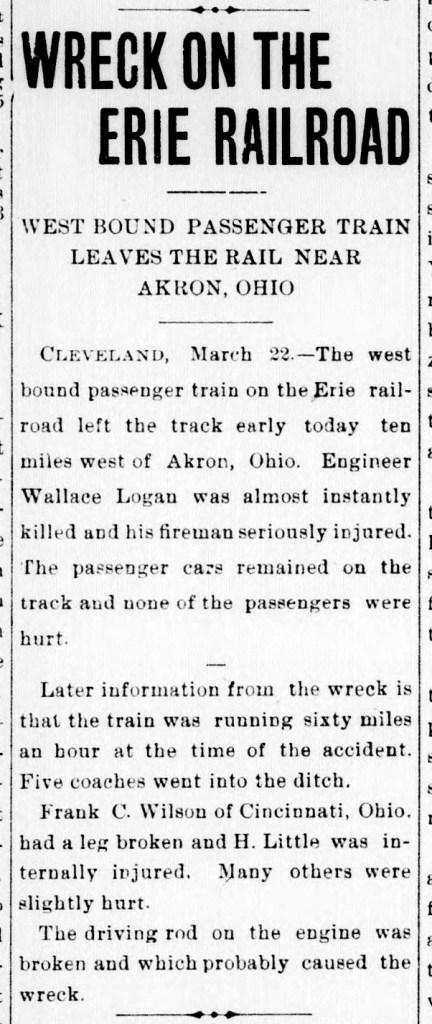
On March 22, 1899, a westbound train derailed near Rittman, Ohio. One source reports that the train had been running at 60 miles an hour, and a later one explains that speeding along this stretch of the Erie Railroad allowed engineers to stay on schedule. Unfortunately, on that run in March, the No. 5 broke a driving rod, which probably lead to the wreck. (Another source uses the term “parallel rod,” but clearly it was some sort of engine trouble.) With even greater speed, news of the tragedy reached Washington, D.C., later that same day and California the very next.
As the No. 5 was veering off the rails, Engineer Alexander Wallace Logan bravely kept his hand on the throttle, sacrificing his life to save passengers and other crew members. He was honored as a hero. Though it received national attention, this single-fatality tragedy was comparatively minor — at least, as late-1800s/early-1900s train wrecks go. For instance, in 1876, a train plummeted 70 feet from a collapsing bridge into Ohio’s Ashtabula River, killing around 90 passengers.
Even so, in October of the same year, a phantom train was witnessed by John Faber, a local doctor, and his companion. The spectral manifestation came again in 1901, this time being observed by “three reputable citizens of Rittman,” named Ewing, Goldner, and Fielding. Interestingly, there are some discrepancies between what we know of the wreck and what was said of that ghostly manifestation.
Were the Wreck and the Manifestations in Different Places?
I suppose discrepancies in the historical record shouldn’t be a surprise. For instance, one paper says the first encounter with the phantom locomotive was on a Saturday while another says Thursday. Rushed reporters still get things wrong to this day. With this in mind, I’ll rely on an article that includes Dr. Faber’s own words, knowing full well he might’ve been misquoted. When the physician and his office boy first encountered the manifestation, they “were driving along the river road.” Faber and friend heard a train approaching. “There appeared to us to be nothing unusual about the train,” he continues,
until it came nearly opposite us. The engine whistled 'down brakes,' streams of sparks shot out of the wheels, and we distinctly heard the 'chuck, chuck' of the reversed engine. Just as the engine reached the bridge there was a flash and a terrific crash and the engine plunged into the stream.
The doctor hurried his horse to the site — but “by the time we had reached the bridge there was not a sign of a wreck to be seen.” Faber confirms that, earlier that year, “an engine jumped the track at the point where I saw the phantom train,” presumably meaning the No. 5.
Now, the bridge where Faber had his encounter — and where he claims the wreck had occurred earlier that year — spans a river called Styx. Yes, that name carries a mythological association with death. However, the photograph below suggests the train didn’t actually plunge into this curiously named stream. Granted, it’s possible the river is not too far behind the camera or hidden just beyond the pile-up, but the train appears to have slipped off the embankment and into a something no more watery than a channel to drain rain water. Indeed, those March articles that reached both coasts say the No. 5 went “into the ditch,” not off a bridge and into a river.
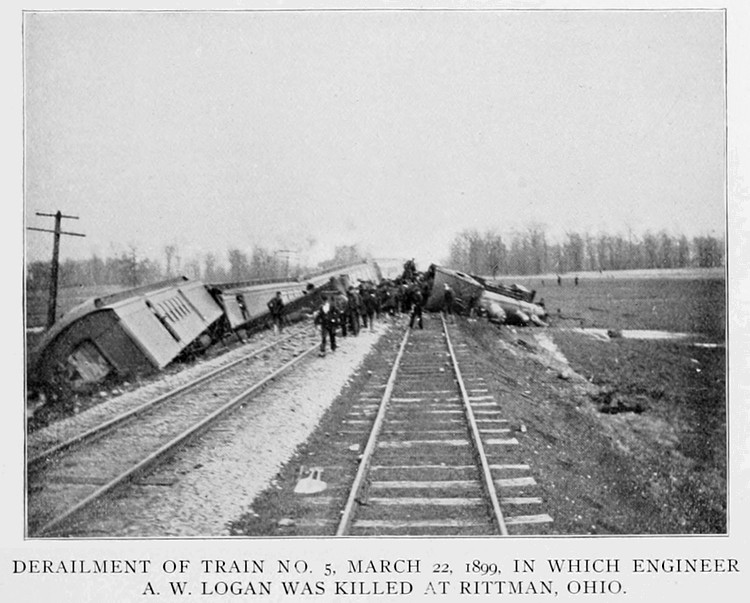
In other words, a half-year after the accident, its spectral reenactment had moved from what appears to be a farm to the Styx, from field to stream. Was Faber consciously or subconsciously “borrowing” images from that much deadlier, much more traumatic wreck that had happened a couple of decades earlier up in Ashtabula or from some similar wreck? Did having the No. 5 plunge into the Styx simply make for a more gripping tale?
Whatever explains the discrepancy between the early reports/photograph and Faber’s encounter, a subsequent sighting of the phantom train occurred near the bridge. In the article about Ewing, Goldner, and Fielding, the Akron Daily Democrat says the wreck had happened “on a trestle over the River Styx near Rittman.” These men’s experience with the phantom train was very similar to Faber’s: they were in the vicinity of the bridge, they heard a train approaching and then crashing, and they “ran down over the embankment to the edge of the stream into which the train had plunged.” However, once there, the trio found that “not a ripple disturbed the placid surface of the water.”
Perhaps they were looking in the wrong place on the tracks. The train wrecked due to engine trouble, remember — not bridge trouble.
Let’s Lengthen the Search
Much more recently, investigators have identified the bridge as the site of the wreck. For instance, John presents an engaging YouTube video about the history of the phantom train, shot and narrated at the bridge itself. Meanwhile, ghost hunter Ken Summers provides an excellent chronicle of his efforts to track down the correct bridge. I wonder, though, if those interested in the case should use the bridge as a handy landmark and wander along a longer path that safely accompanies the tracks.
A current map suggests that safe path might be along East Ohio Avenue or along Salt Street, since both run parallel to tracks crossing the Styx. However, this 1899 map shows the Erie Railroad — which the No. 5 was on — approaches Rittman from the northeast, coming from Wadsworth, while the B&O line approaches from the southeast, from Doyleston. Therefore, East Ohio Avenue is the better bet (as also suggested in this article). If you launch your own investigation, please let us know of the results in the comments section.
Discover more “Railroad Hauntings You Can Still Visit” at the page for
After the End of the Line: Railroad Hauntings in Literature and Lore.
 BROM BONES BOOKS