A Lost Art
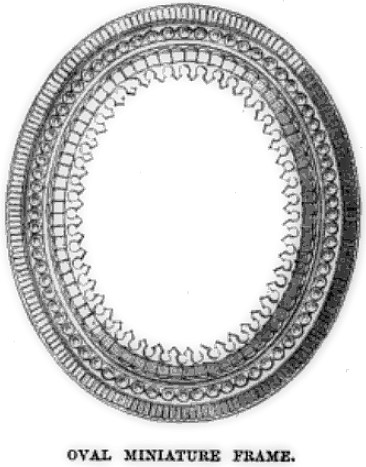
When Catherine Crowe’s “The Lost Portrait” debuted in 1847, readers would have known that a “miniature” is a pocket-sized painting, usually a portrait. Some of those readers might have had a miniature or two of their own — or had admired someone else’s because they were expensive. In fact, they often came with elegant and elaborate frames, as illustrated on the bottom of this page.
Just a generation or two later, though — despite this art’s long history — miniatures had become collectables, charming relics of the bygone past. I suspect the growth and affordability of photography had much to do with this. Maybe our 21st-century equivalent is that picture of a cherished someone carried around on a smart phone.
Crowe’s story hinges on a miniature that isn’t lost so much as stolen, and it becomes a fitting parallel to Nina Melloni, kidnapped granddaughter of Giuseppi Marabini. If such a thing is possible, Nina’s abduction is intended to be in the child’s best interest: she sings so beautifully that a couple of opera patrons feel they must commit the crime, resolutely ignoring any harm it might do. Crowe writes:
    'It's all for her own good, you know,' answered Herbois. 'Isn't it much better that that beautiful voice should be cultivated, and that she should make her fortune, and the fortunes of her family too, than that she should languish here for the rest of her life in poverty and obscurity?'
   'Well, perhaps it is,' answered Michelet, whose notions of right and wrong were apt to be a little confused as well as those of his friend.
One can’t but wonder if Crowe is setting up a criticism of the arrogant privilege and lack of humanity of those wealthy enough to patronize the arts. If so, the remainder of the story fails to develop such a commentary.
From Social Critique to Crime Melodrama?
The remainder of the tale focuses on Giuseppi’s sad journey. His daughter, Nina’s mother, dies. His wife, Nina’s grandmother, dies. He sells his modest vineyard to go in search of the kidnapped Nina. This exhausts his finances, though, and we join him again as he wanders around England.
After a series of twists and turns — and a very crowded cast of characters — the impoverished man is accused of stealing a miniature. The missing item belongs to Sir Henry Massey, and it depicts his wife. Giuseppi is found with a miniature on his person, one carried close to his heart. He claims it’s a picture of his daughter — but, as it happens, there’s a striking resemblance between Lady Massey and the grandfather’s alleged daughter….
It’s not hard to figure out where this headed. Giuseppi is, at long last, reunited with his long lost Nina — now Lady Massey — who looks a lot like her mom. Despite the wild coincidence, there’s a traditional, melodramatic ending to the protagonist’s quest. Hold on! Who really stole the miniature that facilitated this happy reunion? Well, Crowe’s final paragraph names the true culprit, but this gives the piece an odd sense of closure. Was this a crime story all along? It opens with a kidnapping, but Herbois and Michelet are virtually forgotten by the end. It closes with a theft, but the culprit is revealed to be a minor character whose motive is left hazy. The kidnapping and theft create nice “bookends” to the piece, but something seems off, as if Crowe wasn’t entirely sure of the story’s center.
Or does this reflect my own aesthetic expectations?
A Developing Art
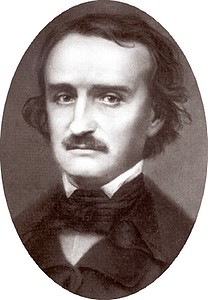
Crowe was no Poe. This statement is painfully obvious, I know, but let me explain. “The Lost Portrait” gives me the impression that, when it came to writing fiction, Crowe thought like a novelist. Many characters. Multiple plot threads. Although Edgar Allan Poe didn’t always follow his own advice, he at least had his “single effect” method of crafting a short story, a narrative form that often would’ve been termed “a tale” in his era. He discusses this approach in an 1842 review of Nathaniel Hawthorne’s Twice-Told Tales, saying:
A skilful literary artist has constructed a tale. If wise, he has not fashioned his
thoughts to accommodate his incidents; but having conceived, with deliberate care, a certain unique or single effect to be wrought out, he then invents such incidents — he then combines such events as may best aid him in establishing this preconceived effect. If his very initial sentence tend not to the outbringing of this effect, then he has failed in his first step. In the whole composition there should be no word written, of which the tendency, direct or indirect, is not to the one pre-established design. And by such means, with such care and skill, a picture is at length painted which leaves in the mind of him who contemplates it with a kindred art, a sense of the fullest satisfaction.
If I understand Poe correctly, he’s saying short-story writers should narrow down what each tale is all about. Don’t start by stitching together an array of plot points (or “incidents”). Start with a “single effect,” which I take to mean a main idea, a unifying point, or possibly a one-sentence theme, such as “A family can be divided — but also united — by a criminal act.” It’s whatever the storyteller wants to linger with the reader after the tale has been told. Poe’s advice remains useful to fiction writers, and so his review is often assigned reading in Creative Writing classes all these decades later.
While genres are made to be broken (or stretched or crossed or spun-on-their-heads), another useful way to focus a short story is to ask if the work-in-process is primarily, let’s say, a crime story. Is it a quest? Is it a social satire of patrons of the arts? A novel might afford the length and flexibility to weave together all three, but “tales” tend not to be so roomy. That is, in Poe’s perspective. And Poe’s perspective has influenced how many readers read short stories today, so no doubt my dissatisfaction with “The Lost Portrait” is related to that.
To better appreciate Crowe’s short fiction, it can help to remember that novels were well-established by the time the “tale” became widely popular. Literacy was on the rise in the mid-1800s. So were magazines serving those readers. So were short stories printed in those magazines. Crowe was working in a narrative form that was still finding its way. As I say, she was probably thinking like a novelist — along with hundreds of other fiction writers — and this helps us understand why short stories in the era of “The Lost Portrait” might feel rather unwieldy to readers reading almost two centuries later.
 BROM BONES BOOKS