Go to Part One
Go to Part Two
The Final Trio
I reached my end-of-2025 reading goal! I completed Arthur Conan Doyle’s four novels and five short-story collections featuring Sherlock Holmes, often referred to as “the canon.” However, I failed to solve the mystery of how or where Dr. John H. Watson went about publishing his chronicles of his remarkable friend and occasional flatmate. Not Doyle, mind you. Watson. According to those tales, the good doctor published his chronicles on a regular basis.
As mentioned in Part One, it’s reasonable to assume that readers in the Holmesverse came upon Watson’s first two narratives A Study in Scarlet and The Sign of the Four in pamphlet form. After all, in the latter, Watson refers to the former as “a small brochure” and “my pamphlet.” As novels go, these first two works are fairly short, making pamphlet somewhat more sensible than book. I’ve only scratched the surface of “true crime” pamphlets published in the Victorian era, and I’m finding they seem to focus on the trial of, say, a murderer rather than on a detective’s investigation of the case. Perhaps in this regard, Doyle was reinventing non-fiction pamphlets to better accommodate mystery fiction.
I’m forced to speculate, though, as to where those readers found the doctor’s many short-story-length chronicles, what he calls his “little narratives.” My guess is some widely read magazine, though I struggle to find any real-life parallel to a series of articles about a single detective’s methods and cases. Certainly, a series of 50-ish articles about any subject would have been very rare. That said, if Watson did published his shorter chronicles in a magazine or magazines, he might have then collected them in books, the pattern that Doyle and many other authors followed in the late 1800s and early 1900s.
Scrutinizing the Evidence
Let’s now examine what I found in the last of the canonical works. Spoiler: nothing very useful to my main concern. There are some secondary points of interest along the way, though.
The Return of Sherlock Holmes
“The Norwood Builder”
Watson, regarding Holmes: “His cold and proud nature was always averse … to anything in the shape of public applause, and he bound me in the most stringent terms to say no further of himself, his methods, or his successes—a prohibition which, as I have explained, has only now been removed.”
Holmes: “Perhaps I shall get the credit also at some distant day when I permit my zealous historian to lay out his foolscap once more—eh, Watson?”
“The Solitary Cyclist”
Watson, regarding Holmes’s many successes and few failures from 1894 to 1901: “As I have preserved very full notes of all these cases, and was myself personally engaged in many of them, it may be imagined that it is no easy task to know which I should select to lay before the public. … I will now lay before the reader the facts in connection with Miss Violet Smith. … It is true that the circumstances did not admit of any striking illustration of those powers for which my friend was famous, but there were some points about the case which made it stand out in those long records of crime from which I gather the material for these little narratives.
“The Six Napoleons”
Holmes: “If ever I permit you to chronicle any more of my little problems, Watson, I foresee that you will enliven your pages by an account of the singular adventure of the Napoleonic busts.”
“The Abbey Grange”
Holmes, taking a stance found in several earlier adventures: “I fancy that every one of [police detective Stanley Hopkins’] cases has found its way into your collection, and I must admit, Watson, that you have some power of selection which atones for much which I deplore in your narratives. Your fatal habit of looking at everything from the point of view of a story instead of as a scientific exercise has ruined what might have been an instructive and even classical series of demonstrations.” With a touch of spite, Watson suggests Holmes try writing one or two himself, and Holmes replies: “I will, my dear Watson, I will.” Indeed, he does so with “The Blanched Soldier” and “The Lion’s Mane,” both in The Casebook of Sherlock Holmes.
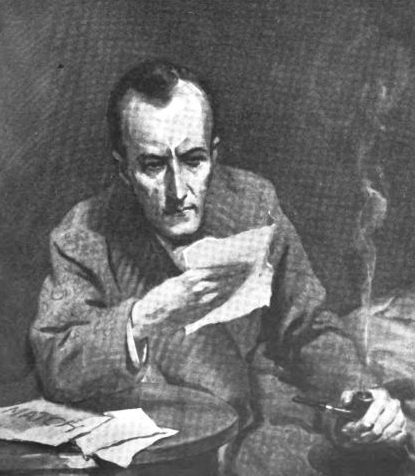
His Last Bow
“Wisteria Lodge”
Holmes, to Watson: “If you cast your mind back to some of those narratives with which you have afflicted a long-suffering public, you will recognise how often the grotesque has deepened into the criminal.”
Holmes, to Scott Eccles: “You are like my friend, Dr Watson, who has a bad habit of telling his stories wrong end foremost.”
“The Devil’s Foot”
Watson, regarding Holmes: “To his sombre and cynical spirit all popular applause was always abhorrent, and nothing amused him more at the end of a successful case than to hand over the actual exposure to some orthodox official, and to listen with a mocking smile to the general chorus of misplaced congratulation. It was indeed this attitude upon the part of my friend and certainly not any lack of interesting material which has caused me of late years to lay very few of my records before the public.”
The Casebook of Sherlock Holmes
“The Three Garridebs”
John Garrideb, to Holmes: “Your pictures are not unlike you, sir, if I may say so.”
I believe this is the first mention of Holmes being “pictured” in Watson’s published accounts of the great detective.
After Holmes says his suit reveals Garrideb, who claims to be American, has been in England for some time, that man adds: “I’ve read of your tricks, Mr Holmes, but I never thought I would be the subject of them.” Here we see a client who knows about Holmes presumably from Watson’s chronicles, something that resurfaces in “The Veiled Lodger.”
“Thor Bridge”
Watson: “Somewhere in the vaults of the bank of Cox and Co., at Charing Cross, there is a travel-worn and battered tin dispatch-box with my name, John H. Watson, MC, Late Indian Army, painted upon the lid. It is crammed with papers, nearly all of which are records to cases to illustrate the curious problems which Mr Sherlock Holmes had at various times to examine. … In some I was myself concerned and can speak as an eye-witness, while in others I was either not present or played so small a part that they could only be told as by third person.” This last remark accounts for “The Mazarin Stone,” which is told in third-person and appears earlier in this collection.
Holmes: “I am getting into your involved habit, Watson, of telling a story backwards.”
“The Veiled Lodger”
Watson opens by explaining that at least one attempt has been made to destroy his records of certain sensitive cases. He then says other cases involved “the most terrible human tragedies.” The chronicle at hand involves one such case, and he adds, “In telling it, I have made a slight change of name and place, but otherwise the facts are as stated.” Here and there, Watson admits to smoothing out a client’s disjointed narration of the problem brought before Holmes, but for the most part he seems to be accurate and reliable. That is—if we’re to trust Watson himself.
I Observe, but I Do Not See
As mentioned, throughout my reading of the canon, I didn’t see anything solid to indicate the medium through which the Holmesverse public read Watson’s chronicles. While pamphlets are likely for the first two novels, what about the many, many stories following? Newspapers? Magazines? Books? A combination thereof? I only observed that the public did read them. And that Holmes routinely snubbed the manner in which Watson told those tales. And that—as Doyle’s output of Holmes adventures grew sporadic—the author “covered his tracks” by putting Holmes in control of which cases Watson was and wasn’t allowed to publish.
One more observation involves a complaint I’ve seen made by some mystery fans: Doyle doesn’t “play fair” with readers. We can’t “match wits” with Holmes because, with Watson as narrator, the detective is allowed to rush off and unravel clues on his own, keeping crucial information secret until The Big Reveal in the final scene. As Holmes states in “The Blanched Soldier” (1926):
The narratives of Watson have accustomed the reader, no doubt, to the fact that I do not waste words or disclose my thoughts while a case is actually under consideration.
These tales come too early, however, to deem this a flaw. At the time the stories collected in The Casebook of Sherlock Holmes were debuting, from 1921 to 1927, some critics were introducing specific rules for mystery writers to follow, including those reader-based conventions involving playing fair and matching wits. (I touch on and link those rules here.) I wonder if Doyle had sensed that his style of mystery-storytelling was fading, and this lurks beneath Holmes’s jibes about Watson’s chronicles being told “wrong end foremost.” In other words, unlike Agatha Christie and her generation, Watson doesn’t narrate events chronologically from, let’s say, the arrival of the client to the exposure of the criminal. Watson doesn’t let readers play the game that’s afoot alongside the detective.
But that’s on Holmes himself, the tight-lipped bugger.
 BROM BONES BOOKS