
Curated Crime Movies Main Page
BOWIE: Look.
KEECHIE: What is it?
BOWIE: It's the Mississippi. We're almost there.
KEECHIE: It's a big river, isn't it?
BOWIE: It's the biggest. Someday, I'd like to see some this country we go traveling through.
KEECHIE: By daylight you mean? That'd be nice.
At Large
If your image of 1940s cinema is dominated by the light, fanciful movies starring Fred Astaire and Ginger Rogers—or maybe Cary Grant and Katharine Hepburn—1948’s They Live by Night might come as a surprise. It’s directed by Nicolas Ray, who’s probably better remembered for Rebel Without a Cause (1955), starring James Dean. Ray gave the earlier film, his directorial debut, the dark edge of film noir coupled with a “plight of the downtrodden” strain found in, say, On the Waterfront (1954) and The Man with the Golden Arm (1955). In this sense, They Live by Night might be seen as a transitional work, taking a big step away from glitsy escapism and toward gritty realism.
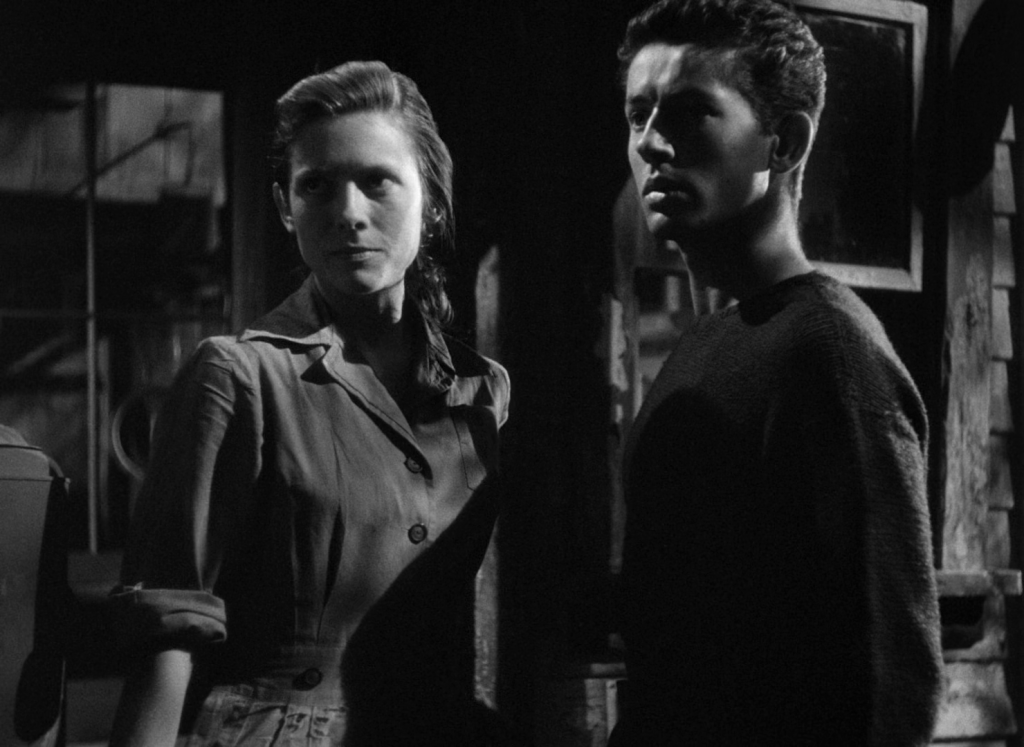
The story concerns young Arthur Bowers, a.k.a. Bowie, a.k.a. Bowie the Kid, who is introduced escaping from prison with two other convicts. Bowie, who was just 16-years-old when he was convicted of murder, intends to hire a lawyer to have his sentence overturned. In other words, he’s motivated to join his fellow escapees in a bank robbery. And his fellow escapees, both considerably older than Bowie, are motivated to keep him around as a member of their gang. The problem is Bowie has met and fallen for Keechie, the niece of one of the convicts. Bowie and Keechie are both products of broken homes, and they share a desire to find a better life. A better life together. A better life beyond the relentless pursuit of law enforcement.
Playing Bowie is Farley Granger, who also appears in Rope (1948) and Strangers on a Train (1951), both directed by Alfred Hitchcock. Cathy O’Donnell plays Keechie, and she also has roles in The Best Years of Our Lives (1946) and Ben-Hur (1959), both directed by William Wyler. Here, though, she pushes hard against the Hollywood tradition of a glamorous leading lady.
Arresting Features
KEECHIE: I don't know much about kissing. You're gonna have to show me.
BOWIE: I don't know too much about it myself. We'll learn to together.
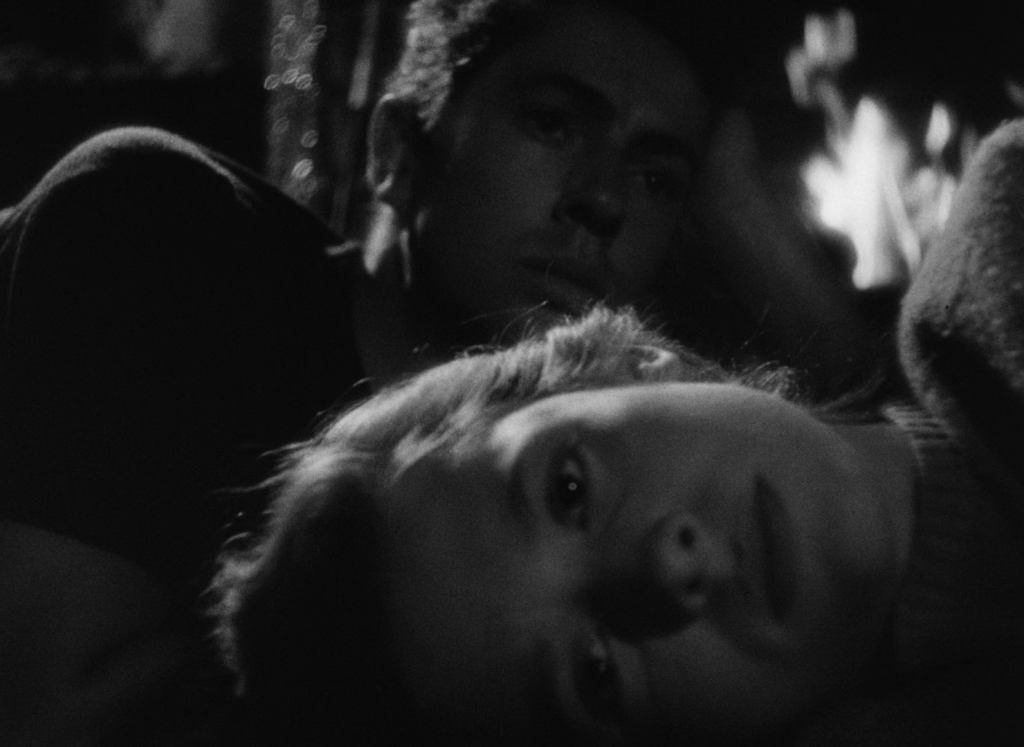
On the one hand, They Live by Night gives us a romance vaguely along the lines Astaire & Rogers or Grant & Hepburn or even Bogart & Bacall. But in this case, the couple’s happiness is continually blocked by Bowie’s entanglement in crime. As suggested by the kissing confession above, some of the pair’s dialog rings a bit artificial, if not clunky. Yet, oddly enough, this somehow melds smoothly with that cynical realism that, while rooted in film noir, is also moving toward films-to-come.
In addition, there are times when the dialog is pretty hard-hitting. For instance, as a Christmas carol plays in the background, Bowie returns to find the cottage where the couple has been laying low is flooded.
BOWIE [Angry]: You said you weren't here when the pipes bust. Where were you? I asked you where you were!
KEECHIE: Seeing a doctor.
BOWIE: About what!
KEECHIE: The baby we're gonna have.
BOWIE: Well, that's just fine! That's all I need!
KEECHIE: You don't see me knitting anything, do you?
Wait. Did Keechie just imply she’s not planning to keep… Oh. Oh my. Well, can’t say as I’ve ever heard that addressed in a 1940s movie! (Spoiler: later, she tells Bowie that she is going to keep the baby.)
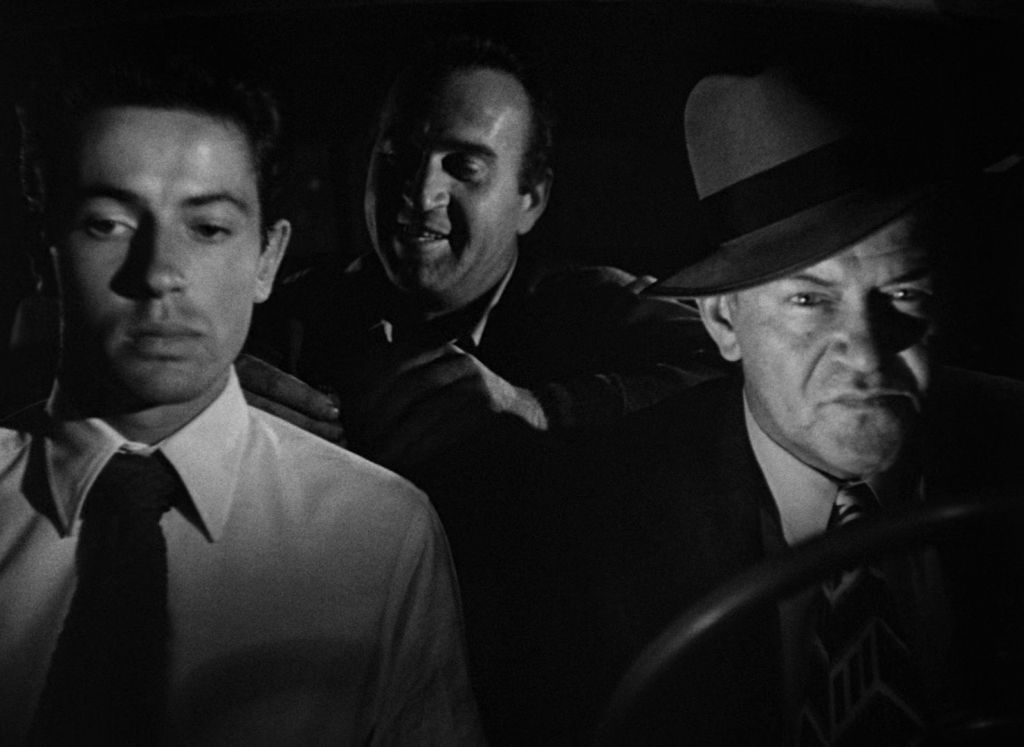
Along with the couple’s rocky relationship, They Live by Night offers side characters with significant flaws and internal conflicts. Keechie’s father is a drunk. Chicamaw, one of the escaped convicts, seems more interested in making headlines by committing crimes than in remaining unidentified. Mattie, the other convict’s sister-in-law, must make a decision that will haunt her long afterward. There’s some nice characterization here.
There’s also some very interesting cinematic storytelling. Ray and his Director of Photography, George E. Diskant, employ some of the very first helicopter shots in film history along with ample location shooting and striking lighting and composition. With an eye on these secondary characters and artistic flourishes, I found myself more engaged the second time I watched the film, and the combination of these strengths explain why They Live by Night has a critics’ score of 96% at Rotten Tomatoes.
In Cahoots
If you find They Live by Night to your taste, you might consider reading Josiah Flynt’s The Rise of Ruderick Clowd and Miriam Michelson’s In the Bishop’s Carriage, offered together as a “partners in crime” volume in the Curated Crime Collection. Flynt’s novel shares the film’s rough-hewn realism and cast of downtrodden characters. Michelson’s story opens with a romance burdened by a man caught in a cycle of crime, though her heroine eventually succeeds in finding a way to, essentially, “live by day.” Of course, the three works are very different in some ways, but they all explore how a criminal life is a product of environment, of thrill seeking, and of poor choices.
Learn more about all of the selections found in the Curated Crime Collection by clicking here.
Curated Crime Movies Main Page

 BROM BONES BOOKS