
Curated Crime Movies Main Page
WILLIE: Are you talking about actually doing this or what?
JOE: Yeah. Actually doing this.
WILLIE: Do you hear what you're saying?
JOE: Look, let me tell you something, Willie. I gotta look back and say that my life was okay. I got my share of everything but money. And the guys who went out for that, some of them got it today, but they put too much time in getting it. Whatever—that's history. Right now, here we are, and I ain't complaining. But things would be a hell of a lot easier if we had a little extra cash.
At Large
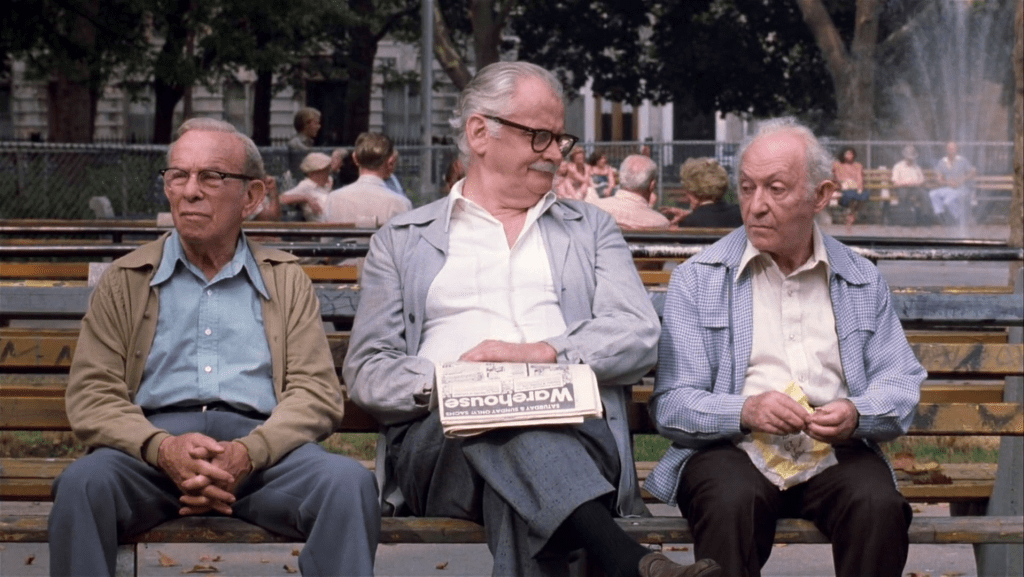
I went into Going in Style (1979), written and directed by Martin Brest, thinking it was a comedy. Given that the premise is three retired guys try to rob a bank—and given that the three guys are played by George Burns and Art Carney, both well remembered for their comedic performances, along with acting expert Lee Strasburg—I went so far as to assume it was probably a broad comedy.
I was pleased to find out I was dead wrong.
Yes, there are many funny moments sprinkled throughout Going in Style, but it’s also a portrait of three men on limited income, struggling to find some kind of thrill and some kind of financial cushion as they near their final rest. In other words, at times, this film is a moody and meditative piece less about wacky old codgers trying to get away with a major crime and more about elderly gentlemen seeking an alternative to quietly waiting until death alleviates their boredom.
This is Brest’s directorial debut, and he went on to helm Beverly Hills Cop (1984), Midnight Run (1988), Scent of a Woman (1992), and Meet Joe Black (1998). It has a critics’ score of 82% at Rotten Tomatoes. (A remake was made in 2017, but its critics’ score is painfully lower, so low I couldn’t be bothered.)
Arresting Features
Going in Style asks an important question: prior to committing armed robbery, especially when robbing a very nice bank, should one shave? It’s a question that’s both absurd and perfectly reasonable, and the scene in which the three men discuss it doesn’t follow the standard setup-punchline-setup-punchline rhythm found in many comedies. That holds true for most of the humor: it’s a juxtaposition of the ordinary and the extraordinary that prompts laughs.
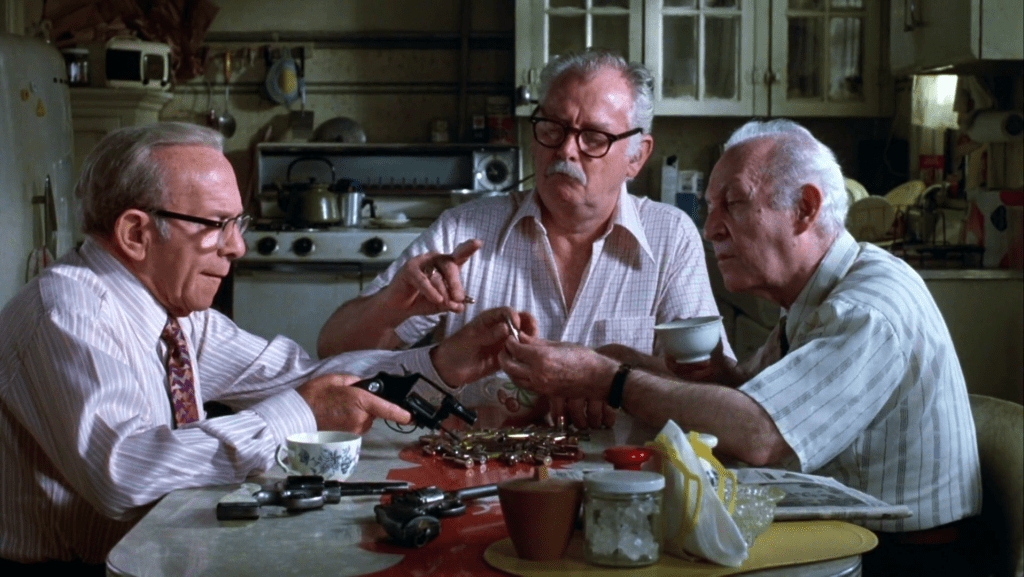
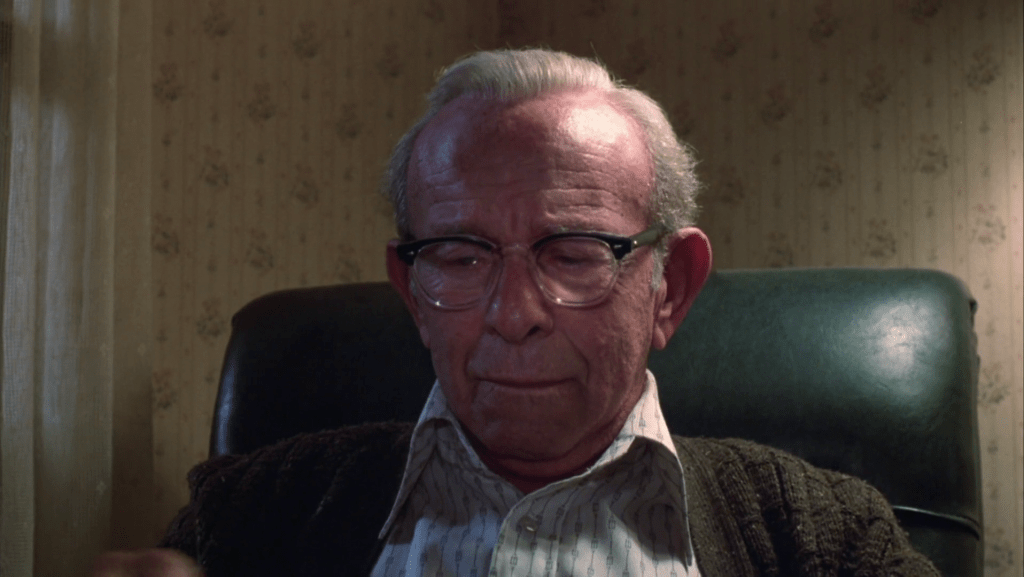
Along with the moments of comedy, there are moments of quiet desperation. For instance, Willie is given a moonlit monolog about being haunted by a terrible mistake he made raising his son long, long ago. Joe has a touching and tearful moment, gazing at old pictures and suffering one of the worst humiliations of old age. (I doubt that critic Bobby Rivers is alone when he says Burns gives “the best performance of his film career.”) And while the robbery brings the old men an afternoon of euphoria, sometimes euphoria isn’t doctor-recommended for those of a certain age.
JOE: You know, for the first time in fifteen years, I feel like I need a vacation. Why don't we take some of that money and go to Hawaii or Miami—someplace nice like that?
AL: Hmm. Yeah?
JOE: Yeah, why the hell not? Let's go out to Las Vegas. Always had to be a two-dollar bettor. Now, I could do some real gambling, and you can get some rest.
AL: Sounds good to me. How do we get there?
JOE: I don't know. Plane, I guess.
AL: I never been on a plane before.
JOE: Neither have I. So what? We're only young once.
On the other hand, two elements of the film struck me as being out-of-place. First, Michael Small’s music score features old-timey, Dixieland Jazz-ish interludes. Was this designed to give the film a lighter, more comic tone? It feels at odds with and too consistent for the film’s range of narrative moods. Second, there’s a Las Vegas craps table scene that goes on longer than need be. The joke is that Joe and Al are trying to splurge a bit with the spoils of their crime, yet they somehow manage to increase their ill-gotten capital. That’s potentially a nice touch. But, as such, it’s too much for a touch.
In Cahoots
There’s a curious kinship between Brest’s Going in Style and Henry A. Hering’s The Complete Crimes of the Burglars’ Club, one of volumes in the Curated Crime Collection. Like the film’s trio of bank robbers, the book’s club members are men who ache for an escape from day-to-day doldrums. Both the movie and the eighteen interwoven short stories are spiced with dashes of humor. In the first of Hering’s tales, for instance, the robber stumbles upon his victim and learns he’s suffering from something far, far worse than the theft of a box of his fancy cigars. As an act of sympathy, the robber kindly offers his sorrowful “mark” one of those very same cigars.
Despite these shared motives to commit crime and moments of humor, members of the Burglars’ Club don’t need what they steal nearly as much as Joe, Al, and Willie do. While the latter refuse to return the stolen money, Burglars’ Club rules stipulate that all stolen articles be promptly restored to their owners. Brest’s criminal characters are of a decidedly different class/income bracket from Hering’s thrill-hungry aristocrats, and the age difference matters, too. Yet in a curious way, the book’s thieves have more to lose: along with lofty reputations, more years left to live mean more years behind bars. These differences make those similarities between the movie and the book all the more intriguing.
Curated Crime Movies Main Page

 BROM BONES BOOKS