
A Rocky Mountain Haunting
Until now, all but two of the U.S. railroad hauntings I’ve discussed in this series are located east of the Mississippi River. I guess that makes sense: a denser population means more railroads and more newspapers. And more ghosts.
But here’s one set in a train tunnel in the Rocky Mountains, roughly fifteen miles east of Bozeman, Montana. Originally part of the Northern Pacific Railroad, the tunnel was constructed between 1882 and 1884, and a report that it might be haunted appeared in April of 1885. Unlike some of the cases I’ve researched, news of this one doesn’t seem to have traveled very far, not even beyond what was then the Montana Territory. The earliest article I’ve found was in The Bozeman Weekly Chronicle, and this was reprinted in the Helena Weekly Herald about a week later. A week after that, it was summarized in The Billings Herald.
Here’s that first report in the Chronicle:
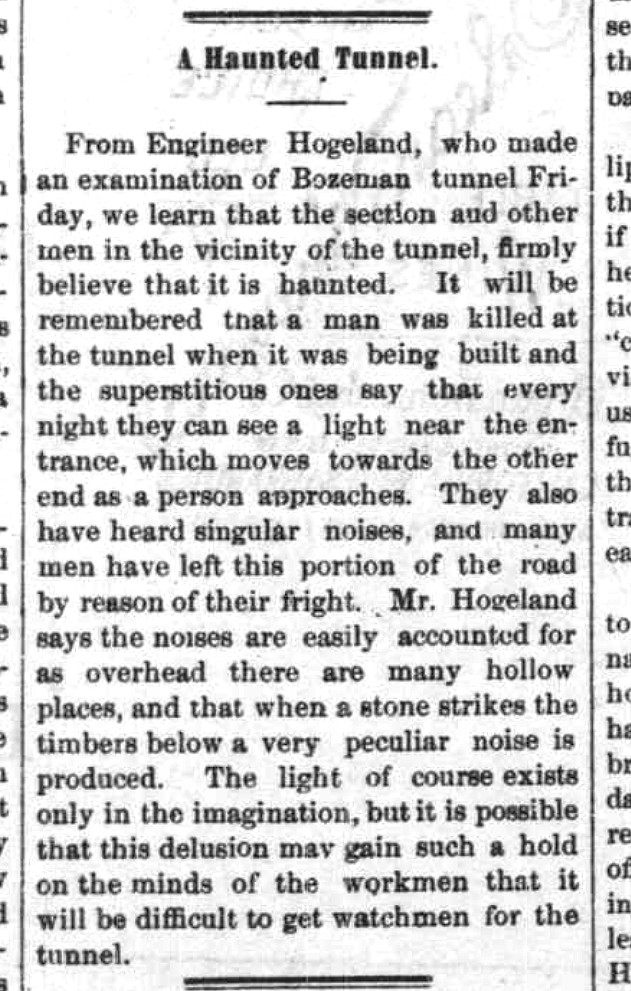
The explanation used to debunk the haunting strikes me as shaky. Attributing the guiding ghostly light—perceived on a regular basis by multiple people—to mere imagination seems perfunctory. This curt explanation might give one the impression that it is itself lacking in imagination or is a product thereof. Furthermore, while “singular noises” is a vague phrase, the witnesses were “section and other men in the vicinity of the tunnel,” people who would presumably be familiar with the structure’s sounds. I doubt it would require an engineer to deem the noises something perfectly ordinary, if they were such.
No, I maintain that there was something occurring at Bozeman Tunnel beyond fantasy and falling stones.
A Ghost Named Gus?
Though it doesn’t substantiate anything paranormal, the article provides an enticing clue to the mystery when it says “a man was killed at the tunnel when it was being built.” I had to dig fairly deep to uncover evidence clarifying this detail (though not so deep, you can run a train through the hole left behind).
In March of 1883, a premature blast was said to have killed one man, but no name is given. In August of that year, a report that the collapse of a platform had killed a dozen men proved to be an exaggeration: six men were injured and no one died in the incident. And in November, a man named “Pat Keating” and “Gus Keating” in two spots on the very same page of the Chronicle is identified as a fatality of a cave-in.
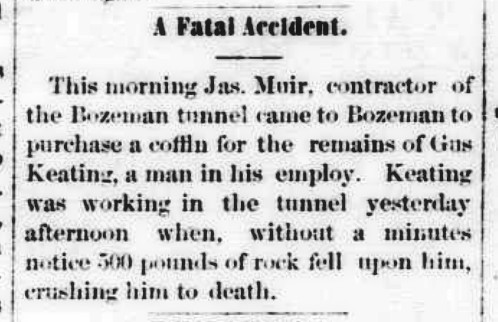
It seems, then, that at least two men, the unnamed victim of a blast and Mr. Keating, lost their lives during construction of the tunnel. However, this is as much a backstory for a ghost as it is inducement for interpreting weird sounds and a moving light to be of spectral origin.
Visiting the Site Today
In the 1940s, a new tunnel was built a bit to the north to accommodate wider trains. This parallel tunnel is now part of the BNSF Railway and, therefore, should be strictly avoided by any paranormal investigators curious about the site. I’m not able to learn how accessible the old tunnel’s east and west entrances are or if the tunnel itself remains open. It is an old, old tunnel, and personally, I’d be much more anxious about all the natural dangers inside it than anything supernatural that might still be there. Luckily, the 1885 report suggests any lingering phenomena probably can be observed outside the tunnel and hopefully from a considerable distance.
That said, the old tunnel is easy to find with the western entrance, near West End, being just south of where Bozeman Hill Road and Beacon Hill Road meet. The east entrance is at a place called Muir, named for James Muir, the contractor who purchased Mr. Keating’s coffin.
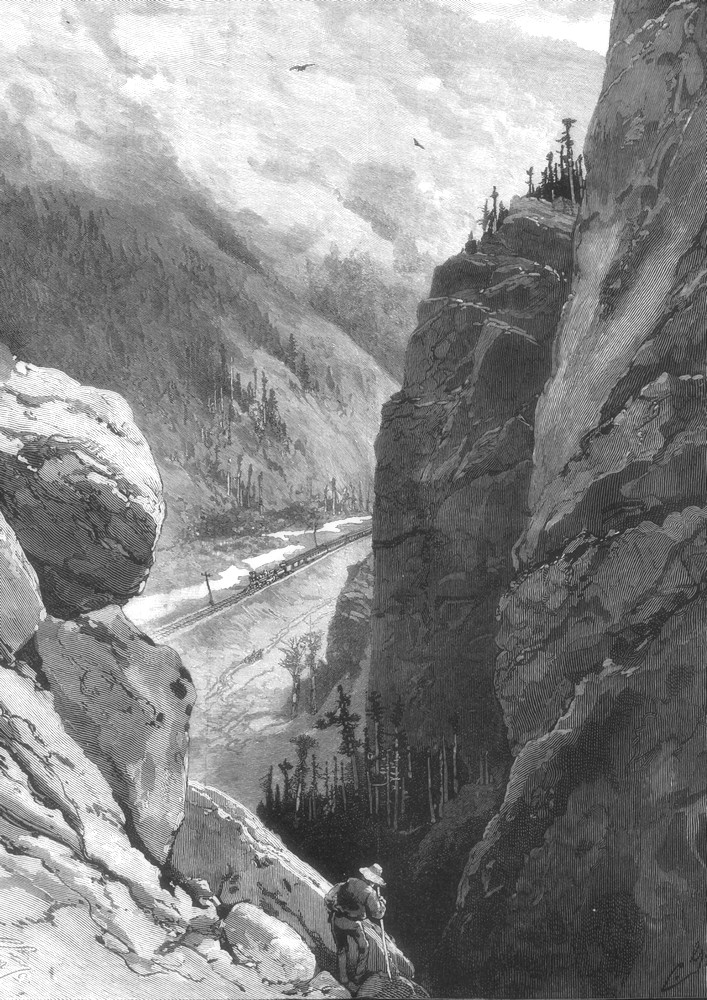
Paul Walters offers a thorough, well-written history of the Bozeman Pass and the Northern Pacific Railroad’s presence there. The pictures he provides are great, and since the tunnel is in a fairly remote place, maybe ghost hunters or train buffs will be perfectly content to scroll down his essay instead of visiting the location in person. Just the same, comments from anyone who has looked into the matter would be warmly appreciated.
Discover more “Railroad Hauntings You Can Still Visit” at the page for
After the End of the Line: Railroad Hauntings in Literature and Lore.
 BROM BONES BOOKS