
Curated Crime Movies Main Page
KEMPTON: I'll give them the painting. They'll put it on exhibition, charge the public to see the Duke, and give me the proceeds. Bingo!
JACKIE: How much would an exhibition raise?
KEMPTON: £30,000? £50,000? Who knows? The painting's not been out of the news, has it? I'll be able to pay for God knows how many TV licenses.
JACKIE: You're not really going to use it all on telly licenses!
KEMPTON: Why not?
JACKIE: Just saying, who couldn't make use of a couple of grand?
KEMPTON: You think Robin Hood took a rake-off?
At Large
This is factual. In 1965, Kempton Bunton stood trial for stealing Francisco Goya’s painting Portrait of the Duke of Wellington from London’s National Gallery. The 61-year-old pensioner of very modest means had confessed to the crime, after trying to ransom it in exchange for £140,000 being allocated to cover pensioners’ television license fees. That amount was the same as the painting’s valuation at the time of its theft.
After all, Bunton was holding a stolen masterpiece for ransom, but he wasn’t out to cheat anyone.
The Duke is a 2020 biopic following the events. Based on what I’ve read, it follows those events pretty closely, including the ones that became public many years after the theft and the trial.
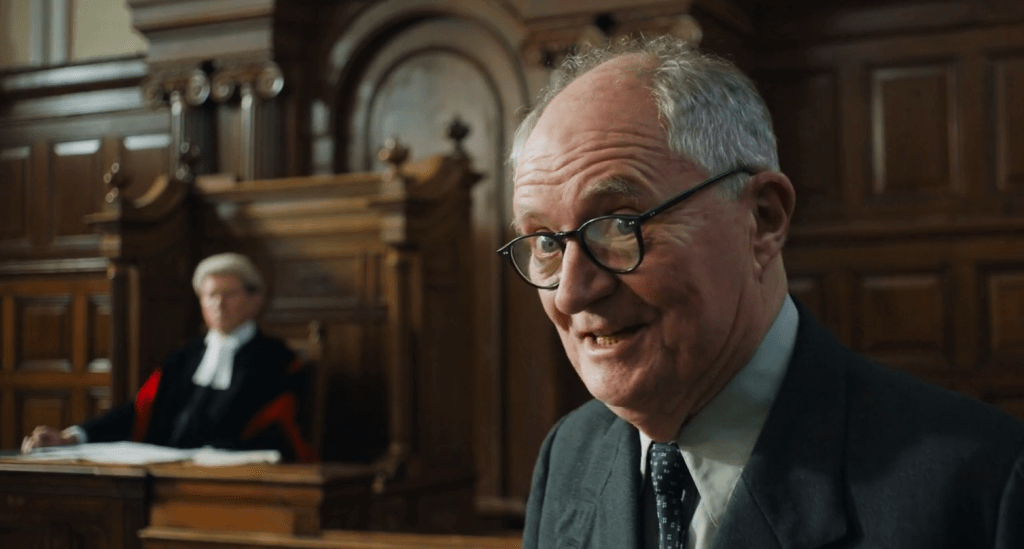
Jim Broadbent stars as the bighearted and chatty Kempton Bunton, and Helen Mirren plays his distraught and laconic wife, Dorothy. It was directed by Roger Mitchell, perhaps best known for Notting Hill, the rom-com of three years earlier.
Funny and enchanting, The Duke has a 97% critics’ score at Rotten Tomatoes.

Arresting Features
Much of the humor in The Duke grows from the fact that the characters and plot are, well, fact. However, that humor never overtakes the film’s depiction of these characters’ humanity. As their backstory is revealed, we learn the Buntons suffered the loss of a daughter in a bicycle accident, and repressed grief prompts tensions in the marriage. Guilt for the death also begins to explain Kempton’s drive to serve the Greater Good. I suspect this level of depth is what attracted actors of Broadbent and Mirren’s status to the project.
KEMPTON: You've never let me talk about it.
DOROTHY: Grief is private.
KEMPTON: I bought her that bike. If I got her anything else, she'd still be alive.
DOROTHY: Well, she isn't.
Need I say that their performances are admirable and engaging? While I’ve seen Broadbent in somewhat comparable roles, I can’t say I recall seeing Mirren portray a dowdy, working-class housewife before. And their fine work is reflected by the entire cast.
The film also gives viewers, even those far removed from the time and place, a good sense of life in 1960s Newcastle, England. Most of Mitchell’s cinematic storytelling doesn’t draw attention to itself, allowing the audience to become absorbed into realism. However, on occasion, he borrows an eye-catching transition involving—well, I don’t know what to call it other than moving split-screens reminiscent of groovy movies from that decade. It’s a style choice that enhances the period feel without sacrificing the narrative substance.
In Cahoots
Interestingly, Bunton’s legal defense loudly echoes the one used to exonerate the title characters in Henry A. Hering’s The Complete Crimes of the Burglars’ Club, one of the volumes in the Curated Crime Collection. Once upon a time, British law held that, to qualify as theft, the intention must be to keep the article in question, not to merely borrow it. They steal from the rich to give back to the rich (while hopefully that first part relieves a bit of their boredom).
In other words, the members of the Burglars’ Club don’t share the same motive as Robin Hood. Bunton is a different species of scoundrel, too, one who is more in keeping with Robin of Loxley.
In that Bunton hopes the missing masterpiece can be used to help the economically disadvantaged, The Duke better reflects the con man who repeatedly preys on the title character of Grant Allen’s An African Millionaire. (This composite novel is combined with Allen’s daring “The Curate of Churnside” in a single CCC volume). Sure enough, Grant’s master criminal, known as Colonel Clay, has no particular desire to giveth to the downtrodden. Instead, Clay is determined to taketh away from a millionaire whose business practices, while technically legal, are often far from ethical. In other words, Clay prefigures Bunton in using crime to combat a questionable if not corrupt legal system, and for this reason, Grant’s playful tales are as satisfying to read as The Duke is to watch.
Curated Crime Movies Main Page

 BROM BONES BOOKS