*Trusted Archival Research Documents in Sequence
INTRODUCTION
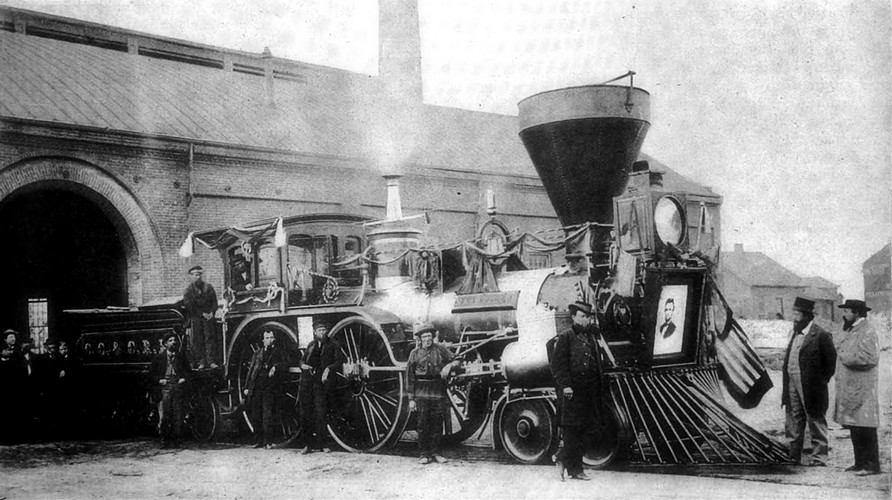
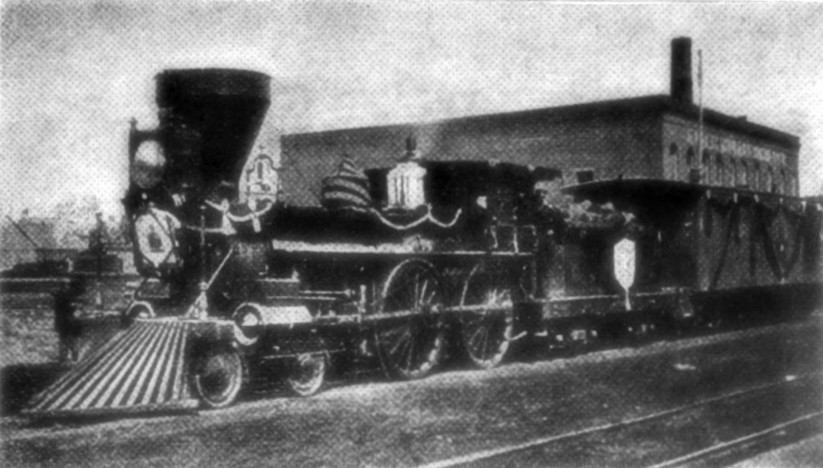
This chronology is a “branch line” of my Railroad Hauntings You Can Still Visit project. My goal is to organize information related to a ghostly reenactment of Abraham Lincoln’s funeral train. As John Carrol Power explains, in 1865, a train carrying Lincoln’s body embarked on this route: “Washington to Baltimore, thence to Harrisburg, Philadelphia, New York, Albany, Buffalo, Cleveland, Columbus, Indianapolis, Chicago to Springfield [Illinois].” All along the twelve-day journey, the train was met by crowds of mourners. Perhaps this outpouring of grief left an ethereal imprint, somehow explaining why reports of a ghost train began to appear in newspapers about seven years later.
I devote the first part this chronology to specifics on the 1865 funeral train schedule, calling it “When and Where to Look” with ghost hunters in mind. You see, the spectral train was reported to be an anniversary ghost, meaning it manifests close to the same calendar date as the physical train had passed. The hours here appear in Standard Time, the way they were recorded because Daylight Savings Time hadn’t been instituted. ST + 1 hour = DST. Also, I tried to indicate when the original train was moving at night because 1) that’s when the ghost train was said to be observed and 2) ghost hunters tend to be nocturnal.
The second part, called “What to Look For,” starts at 1872 and recounts several historical descriptions of the ghost train.

WHEN AND WHERE TO LOOK
🚂1865
April 15
U.S. President Abraham Lincoln died from John Wilkes Booth’s gunshot received the previous evening. This happened in Washington, DC.
April 21: Washington, DC, to Baltimore, and on to Harrisburg, PA
The train departed at 8:00 a.m., according to Power, heading to Baltimore and arriving at that city’s Camden Street Station at 10:00. It had run on the tracks of the Baltimore & Ohio Railroad, and the 1865 edition of Disturnell’s Railway and Steamship Guide shows the towns it would have passed: Bladensburg, Beltsville, Laurel, Elkridge, and others. It’s very likely groups of mourners gathered at these spots.
At 3:00 p.m., the train departed Baltimore for Harrisburg, PA, having transferred to the Northern Central Railway. Jim McClure’s “Lincoln’s Funeral Train in York, PA: ‘He was crucified for us’,” at InYork.com, shows a digital copy of a timetable titled “Special Schedule for the President’s Funeral.” This is a great source listing the stations and times for this part of the journey.
An article in the New York Herald describes the crowds gathered along the line while offering an alternate timeline. Maryland towns include Lutherville (3:40), Cockeysville (4:00), Phoenix (4:12), and Monkton (5:30). Pennsylvania towns include Shewsbury (6:00) and York (6:50, which the article says was “near nightfall”) before arriving at Harrisburg (8:30). In other words, the trip after York—including Conewago, Goldsboro, Red Bank, and Bridgeport, according to that “Special Schedule”—would have been in the dark.
April 22: Harrisburg to Philadelphia
The train departed Harrisburg at 11:00 a.m., now using the tracks of the Pennsylvania Railroad. Remembering Lincoln, a project of Ford’s Theatre (where the President was assassinated), offers a digital copy of a timetable titled “Schedule for Special Train, With the Remains of President Lincoln, to be Run from Harrisburg to Philadelphia.” Here’s another great source for seeing where and when the train passed. Apparently, this schedule had been been printed fairly close to the actual run—it matches the times noted by Power, even though he says the train organizers acted “to have as much daylight as possible for the procession at Philadelphia” by leaving Harrisburg an hour earlier than first planned. He also mentions crowds gathered in the following towns: Middletown, Elizabethtown, Mount Joy, Landisville, Dillerville, Penningtonville, Parkesburg, Coatesville, Gallagherville, Downington, and Oakland.
Power then describes the train’s arrival at Philadelphia: “Minute guns heralded the news as the train passed on to the depot of the Philadelphia, Wilmington & Baltimore railroad, on Broad street. Here the people were not counted by thousands, but by acres.” It slowed to a stop at 4:30 p.m., “one hour in advance of schedule time.”
I was sorry to read that the PW&B station was torn down in the 1940s. I was pleased, though, to learn a freight house built next to it in 1876 was renovated and now houses a supermarket.
April 23
The President’s body remained in Philadelphia.
April 24: Philadelphia to New York City
The train departed Kensington Station shortly after 4:00 a.m.. “The sun was now rising in its full glory” as it reached Bristol, says the New-York Daily Herald. It paused in Morrisville, PA, at 5:30 to pick up New Jersey governor Joel Parker and then crossed the Delaware River to stop again at Trenton for half an hour. On resuming, the train passed New Brunswick (7:30), Rahway (8:25), Elizabeth (8:45), Newark, and Jersey City.
The coffin was then ferried across the Hudson to New York City.
I’m still unsure if this leg of the trip utilized the tracks of the Camden and Amboy Railroad, the New Jersey Railroad, or some combination of companies. Regardless, the very handy Disturnell’s Guide names some additional towns where mourners might have held their daylight vigils.
April 25: New York City to Albany
Leaving the Thirteenth-Street depot, the train traveled north on the Hudson River Railroad. According to the New-York Daily Tribune, it embarked “after 4 o’clock” in the afternoon and rolled past mourners in Fort Washington, Yonkers, Hastings, Dobb’s Ferry, Irvington, Tarrytown, Sing-Sing, Peekskill, West Point, Cold Spring, Fishkill Landing, Newburgh, and New Hamburg. The train then stopped at Poughkeepsie. It resumed at 8:10, as stars were “shining in a clear and calm sky,” and passed Rhinebeck (8:35), Barrytown (8:50), Trivoli, Germantown (9:15), Catskill Landing (9:35), Hudson (9:45), Stuyvesant, Schodack, Castleton (10:30), and stopped again at East Albany (11:00), where the President’s remains were conveyed across the Hudson and to the State House.
That article mentions almost all of the stops on the usual train route. However, Disturnell’s Guide mentions a few more, such as Hyde Park—and it’s at Hyde Park where one can find a historical marker commemorating the funeral train and its supernatural twin. See 1879 below for two accounts of the ghost train observed on the Hudson River Railroad. Is this stretch of track a hotspot for encounters because much of the original run happened at night?
April 26: Departure from Albany, Heading to Buffalo
According to the Daily National Intelligencer, a paper published in Washington, DC, the train departed Albany at 4:00 p.m. and reached St. Johnsville at 7:00. The above article about the train passing through York, PA, says at 6:50 was “near nightfall.” We can presume, then, the rest of this trip through upstate New York was in the dark. The train then passed through Little Falls, Herkimer, Utica, and Syracuse (11:50). Despite the late hour and rain, according to the New York Daily Tribune, “at least thirty-five thousand people witnessed the passage of the train” in Syracuse alone.
The train followed the New York Central Railroad line. Here’s an 1878 schedule showing the many towns on the company’s line between Albany and Buffalo. (Hathitrust offers one from 1868, but access is restricted. Not surprisingly, the towns are almost identical.)
April 27: Arrival in Buffalo, Heading to Cleveland
Power says the train reached Memphis, NY, at midnight, and he provides helpful details about the towns passed in the wee hours. The depots at Weedsport, Jordan, Port Byron, Savannah, Clyde, Lyons, and Newark “were draped in mourning, bonfires and torchlights revealed groups of men and women with bare heads standing for hours in the middle of the night to catch a passing view of the great funeral.” The remaining towns that Power provides specific times for are Palmyra (2:15), Fairport (2:50), Rochester (3:20), and Batavia (5:18). The train arrived in Buffalo at 7:00 a.m.
The westward course was resumed at 10:00 p.m., continuing on the tracks of the New York Central Railroad. The next major destination was Cleveland.
April 28: Arrival in Cleveland, Heading to Columbus
Again, Power provides helpful details about this late-night trip. Still in upstate New York, the train passed Dunkirk (12:10) and Westfield (1:00). Crossing into Pennsylvania (1:32), it visited North East (1:47), Erie (2:50), and Springfield (2:27). Once in Ohio, it rolled past Conneaut (3:48), Ashtabula (4:27), Willoughby (6:08), Wickliffe (6:20), and Euclid (6:32). These intermediate towns coincide pretty well with this Disturnell’s Guide schedule—though it was published in 1857 and names a different railroad line—and so Disturnell might fill in some spots Power omits.
At 7:00 a.m, the train arrived at Cleveland’s Euclid Avenue Station. After spending most of the day there, it departed at midnight, heading to Columbus on the Cleveland, Columbus, & Cincinnati Railroad.
April 29: Arrival in Columbus, Heading to Indianapolis
As with the Harrisburg to Philadelphia trip, we have an excellent source to determine when and where the funeral train ran. It’s the “Special Time Schedule for the Train Conveying Remain of Abraham Lincoln…,” and there’s an online copy thanks to the Huntington Digital Library. It shows that the funeral train was set to arrive in Columbus at 7:30, but Power puts it at 7:00.
After several hours, the train departed for Indianapolis following the Columbus & Indianapolis Railway line. One passenger told the Daily Ohio Statesman that the departure from Columbus was at 8:00 p.m. Amid descriptions of the mournful crowds and displays, the correspondent provides precise arrival times: Pleasant Valley (8:45), Unionville (9:00), Milford (9:19), Woodstock (9:46), Cable (10:13), Urbana (10:40), St. Louis (11:24), and Conover (11:39). This timetable continues on the 30th.
April 30: Arrival in Indianapolis
The Daily Ohio Stateman correspondent mentioned above continues with descriptions of passing the Ohio towns of Piqua (12:30 a.m.), Gettysburg, Richmond, Junction, Covington, Greenville (1:26), and New Paris (2:40). The traveler then crossed into Indiana: Richmond (3:10) and, omitting times and confusing the order, mentions Centerville, Germantown, Dublin, Lewisville, Charlottesville, Knightstown, Raysville, Ogden, Coffin’s (???), Philadelphia, Greenfield, Cleveland, and Cumberland. Presumably, when the train reached Indianapolis at 7:00, it was in the morning light. The President’s body remained there the rest of the day and well into the evening.
May 1: Departure from Indianapolis, Arrival in Chicago
The train departed Indianapolis shortly after midnight, heading to Chicago. It used the Lafayette and Indianapolis Railroad tracks as far as Lafayette, where it transferred to the Louisville, Albany, and Chicago facilities, and then at Michigan City it followed the Michigan Central line.
A correspondent identified as “Dr. Adonis” provided readers of the Chicago Tribune a timeline of the trip. It starts with these Indiana towns: Indianapolis (depart 12:10 a.m.), Zionsville (12:47), Whitestown (1:07), Lebanon (1:30), Thorntown (2:10), Clark’s Hill (2:40), Stockwell (2:50), Lafayette (3:35), Battle Ground (3:55), Reynolds (5:35), Francisville (5:45), San Pierre (6:25), Westville (7:40), La Croix (7:50), Michigan City (8:35), Lake (9:30), and Gilson’s (10:05). At this point, the train crossed into Illinois, with Calumet reached at 10:30 and Chicago at noon. Dr. Adonis’s descriptions of the crowds gathered along the route are well worth reading.
May 2: Departure from Chicago, Heading to Springfield
The final leg of the journey crossed the tracks of the Chicago & Alton Railroad at night. There’s another of those very helpful timetables, this one showing “The Special Train, Conveying the Funeral Cortege with the Remains of the Late President from Chicago to Springfield” at site of Freeman’s auction house. The funeral train departed Chicago at 9:30 p.m., and the Chicago Tribune reported that it had rolled by groups of mourners in Bridgeport and Lockport before reaching Joliet at midnight.
May 3: Arrival in Springfield
Comparing the timetable of the special train with the Chicago Tribune article, both linked above, we see that the train was gradually lagging behind schedule. That article goes on to say that, after midnight, the train passed Wilmington (1:00), Dwight (2:00), Lexington (4:00), Towanda (4:30), Bloomington (5:00), Shirley, Funk’s Grove (5:30), Atlanta (6:00, where “the sun lights up the beautiful prairie country”), Lincoln (7:00), Broadwell, Elkhart, Williamsville, and Sherman Station before arriving at Springfield. Power confirms that the funeral train arrived at its final destination at 9:00 a.m., an hour later than originally planned. An 1875 Chicago & Alton schedule adds a few more towns along the line where onlookers very likely had watched the train pass.
May 4
Lincoln was buried in Springfield, Illinois.
WHAT TO LOOK FOR
🚂1872
According to Adam Selzer, March 23 was the day an article titled “Waiting for a Train” appeared in the Albany Evening Times. Through the rest of that year and into the next, the piece’s ghost train segment was reprinted in newspapers from Connecticut, South Carolina, Wisconsin, Louisiana, Nevada, Oregon, and other states. It showed up in British newspapers, too. This is a key source, one that clearly spread the story about the Lincoln Funeral Ghost Train far and wide.
Here’s the segment that was frequently reprinted:
A writer in the Albany Evening Times relates a conversation with superstitious watchman on the New York Central Railroad. Said the watchman, “I believe in spirits and ghosts. I know such things exist, and if you will come up in April I will convince you.” He then told of the phantom train that every year comes up the road, with the body of Abraham Lincoln. Regularly in the month of April about midnight, the air on the track becomes very keen and cutting. On either side it is warm and still; every watchman when he feels this air steps off the track and sits down to watch. Soon after, the pilot engine with long black streams, and a band with black instruments playing dirges, and grinning skeletons sitting all about, will pass up noiselessly, and the very air grows black. If it is moonlight, clouds always come over the moon, and the music seems to linger as if frozen with horror. A few moments after the phantom train glides by. Flags and streamers hang about. The track ahead seems covered with a black carpet, and the wheels are draped with the same. The coffin of the murdered Lincoln is seen lying on the center of a car, and all about it, in the air, and on the train behind are vast numbers of blue coated men, some with coffins on their backs, others leaning upon them.

It seems that all the vast armies of men who died during the war are escorting the phantom train of the President. The wind, if blowing, dies away at once, and over all the air a solemn hush, almost stifling, prevails. If a train were passing, its noise would be drowned in this silence, and the phantom train would rise over it. Clocks and watches always stop, and when looked at are found to be from five to eight minutes behind. Everywhere on the road about the 20th of April the time of watches and trains is found suddenly behind. This, said the leading watchman, was from the passage of the phantom train.
As yet, I haven’t located the original article—or anything earlier that expressly discusses the spectral train—and I’d very much appreciate help in doing so. Until then, Selzer’s webpage and transcription of that first article is especially useful.
Below, I refer to this source simply as “the 1872 article.”
🚂1879
Perhaps the second most significant newspaper article appeared in the July 29 issue of New York City’s The Sun. Titled “Yarns by a Train’s Crew,” it offers paraphrased versions of a number of tales. Along the way, the reporter shares the paragraph below. The full article or that paragraph also appeared in newspapers as far-flung as Maine, Chicago, Louisiana, and Washington Territory. Given the local interest, it’s not surprising it also popped up in papers across New York.
Here’s the paragraph concerning the “mystic counterpart of the funeral train”:
Then there was narrated a weird story that I had heard once before. It was about an apparition of a train on the Hudson River railroad. It was told with an effort at sincerity that did not deceive the listener, but I am told that there are many trackmen and laborers along the line of the Hudson River railroad who pretend to have seen the spectacle. The tale was about a mystic counterpart of the funeral train that bore Abraham Lincoln’s remains from this city to the West. The actual and substantial train passed over the road on a certain day in April, 1865. The car that contained the President’s remains was heavily draped, I believe. It is said that on that night, every year, all the train men that are on the road during a certain hour (that varies in different subdivisions of the road) hear and see and feel the spectre train rush by them. It sounds hollow and awful. Its lights are yellow, pale, and funereal. Its train hands and passengers are sepulchral figures. It looks like the outline of a train, yet every detail is perfect. Those who have seen it say, though they felt that it was only a vision, that a man could walk through it if he dared, or throw a stone through it; yet it seems perfect in everything but substantialness. It even carries with it a whirl of wind as fast trains do, but it is cold, clammy, gravelike atmosphere, all its own. As it passes another train the shriek of its whistle and clang of its bell strike terror to the hearts of those that hear them.
A new, longer spin on the story appeared later the same year. I found it in the August 28 issue of the Utica [New York] Daily Observer, but it’s attributed to the New York Star. In the style of the 1872 article and the one just discussed, this is couched as a (tall?) tale told by railroad worker, specifically, a retired switchman named Maltwood. It’s too long to reproduce here, and the extensive dialog makes me suspect it’s more fiction than folklore.
🚂1886
The November 6 issue of the Watertown Daily Times, published in New York, included a death notice for Leonard Ham. (The notice appeared in other papers, too, one as far away as Texas.) An odd tidbit says Ham “had charge of the locomotive that drew the [Lincoln] funeral train…from Albany to Buffalo, and which has ever since given rise to a superstition among railroad men that on the same day every year, (April 23,) and at the same hour, a ‘phantom train’ passes over the road.” Newspapers of the time confirm the train departed Albany on the 26th and arrived in Buffalo the next day.
🚂1929
In Myths After Lincoln, Lloyd Lewis retells the tale, leaning hard on the 1872 article. Lewis gives no indication that the phantom train had been seen subsequently.
🚂1931
In Ghost Tales: Short Stories for Use at the Fireside and Campfire, Charles E. Brown (Madison, WI: C.E. Brown) devotes about a page to the haunting, shifting the railroad-employee storytellers from New York to the Midwest. Brown’s book is available at Hathitrust, but access there is restricted due to copyright. Luckily, all five paragraphs were reprinted in 1932 issues of The Milwaukee [Road] Magazine (pg. 14), Railway Age, and The Pullman News, appropriately railroad-related periodicals. Though not nearly to the extent of the 1872 article or the 1879 Sun article, Brown’s narration helped introduce a good many readers to the haunting.
Discover more
“Railroad Hauntings You Can Still Visit”
at the page for
After the End of the Line: Railroad Hauntings in Literature and Lore.
 BROM BONES BOOKS