An Occult Detective in Training
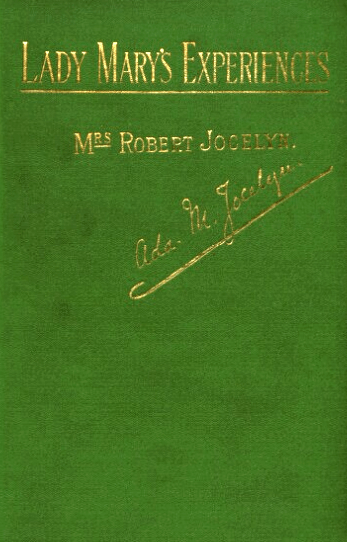
Lady Mary’s Experiences (1897) is a novel by Ada Marie Jocelyn (née Jenyns, a.k.a. Mrs. Robert Jocelyn). A reviewer for The Literary World describes the work’s protagonist, Lady Mary “Molly” Merton, as someone who — after two spectral encounters — “asked for fresh ghosts, and the idea of going to live in a haunted house captivated her.” Upon finding one, Lady Mary “made up her mind to take it, furnish it, live in it, and compel it, so to speak, to exhibit for her pleasure whatsoever phantoms held it on a supernatural lease.” Given this, I figured I might have a work of Victorian occult detection, one made unusual by being of novel-length and by casting a woman in the role of lead ghost hunter.
To be sure, the first 35 chapters were all I had hoped they would be. Jocelyn uses those first two spectral encounters to cleverly illustrate how Lady Mary has evolved into someone eager to investigate haunted places and intent on freeing ghosts from their earthly shackles. The first experience is very basic: Lady Mary learns that she can see a ghost thought to be perceptible only to members of the Englefield family. In fact, she sees that the ghostly “woman in green” can also appear in white and black gowns. Does Lady Mary have a special gift for apprehending apparitions? Well, recounting the adventure, she says that it was learned “that I was distantly related to the Englefields on my mother’s side of the family.” So maybe there’s no special gift.
But then she narrates her second experience, and Lady Mary discovers herself to be what might have been called a “sensitive” or a “ghost-seer” in her own age — and what might be called today a “clairsentient,” an “empath” or, specifically, a “mediumship empath.” This case also calls on her to perform nocturnal surveillance, a spectral stake-out, so she’s on her way to becoming an occult detective.
The third haunting, then, makes up most of the novel, and Jocelyn depicts Lady Mary balancing nocturnal surveillance with witness interviews and rational deduction. The character passes the Occult Detective Qualification Exam as she attempts to unravel the riddle of a house called the Grey Hall. This stately structure is falling into ruin because tenants avoid it, and they avoid it mostly because of its reputation for being haunted or cursed or something else that’s very unappealing. “And I have made up my mind to solve the mystery here,” proclaims Lady Mary, “and lay the ghost also, if that is possible.”
The Grey Hall Mystery and a Unique Holmes and Watson
The primary paranormal phenomena at Grey Hall is no one can sleep there. Not at all! Oh, there are unsubstantiated reports of weird sounds and shadowy figures, but that main manifestation — insistent insomnia — is something that I found distinctive and intriguing. Regarding it, Lady Mary promptly determines what none before her had: the sleeplessness only occurs upstairs. Swap the rooms traditionally on the first floor with the upstairs bedrooms, and an investigator can snoop as long as she likes without being driven away or driven mad by the relentless lack of sleep.
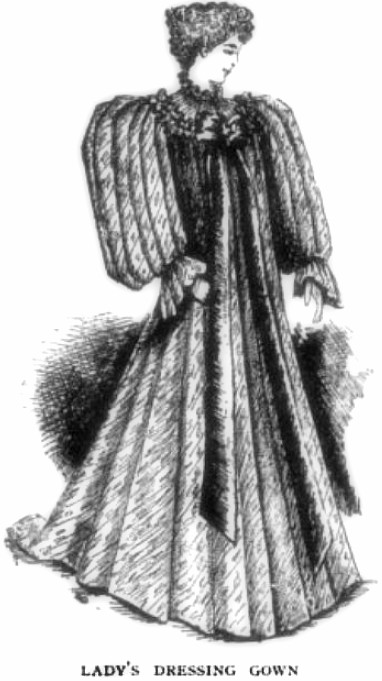
True to form, Lady Mary has a sidekick in this case, a skeptical Scully to her more open-minded Mulder. She’s Veronica Lawrence, and together, they form a duo that one character considers “as capable of taking care of themselves as any two women she had ever come across.” Indeed, Veronica explains that she learned to use a revolver “in a manner which I find reassuring, out in the backwoods of Canada.” At one point, she carries it in her dressing-gown. She also owns a dog named Reckless, “a great, ugly brute” that few can control. Simply put, Veronica is the brawn to Lady Mary’s brain.
We learn early on that the property owner, Lord Artingdale, knows something about the haunting — a nasty family secret — that he’s keeping to himself. This is complicated by the romantic history between Artingdale and Lady Mary. He loved her. And, though she liked him pretty much, she was married. They parted. He pined. She had a kid. He pined. She became a widow. He pined. They meet again when Lady Mary happens upon the Grey Hall. It’s a ghost novel, not a ghost short story, so I guess some romantic entanglement is to be expected.
Does the Romantic Entanglement Explain the Hurtful Finale?
And then Lord Artingdale’s younger brother, Jim Ackroyd, falls for Lady Mary. And vice versa. It’s a mess with a fairly predictable clean-up. But Jocelyn handles it well, and single-parent Lady Mary — even with her youth, beauty, and wealth — is something other than the marriageable miss one meets in, say, a Jane Austen novel. That said, if one is reading Lady Mary’s Experiences to enjoy a typical occult detective narrative, one might grow a bit annoyed by the heavy romance element. But that’s not what ultimately hurts the novel.
The novel’s greatest weakness, I think, is its conclusion. For 35 chapters, the author has been presenting Lady Mary and Veronica as smart, brave, and tenacious. There’s a great scene toward the end involving Jim and Lady Mary urgently wanting to get upstairs while Reckless prevents them from using the front stairs. She suggests they fetch a ladder to climb in through a portico window. Jim suggests that, instead both of them going, Lady Mary retreat to someplace safe. “I am coming with you,” says she, “so do not waste any time in arguments.” He accepts this. On the way to the ladder, lovestruck Jim insists Lady Mary promise to marry him. She consents, adding, “Only please do not let us lose any time.” They soon arrive at the ladder, and Lady Mary grabs one end. Jim tries to halt this, too. Jocelyn writes:
In spite of his protests, she secured the lighter end of the ladder, and as she seemed determined to retain it, as usual he was obliged to give in and let her do so.
In barely more than two pages, Jocelyn has forecast a marriage in which Lady Mary continually throws cold water on Jim’s desire to make himself a conventional man-in-charge and his wife into a conventional damsel-in-distress. It feels very modern.
But just a couple of chapters later, our occult detective with the ability to see ghosts witnesses the terrible spirit that presumably keeps people awake. Jocelyn writes:
Jim Ackroyd saw nothing, but that something appalling must have been seen by Lady Molly, he had no doubt, and a moment later he received her unconscious form in his arms.
No woman has come anywhere close to fainting at any point until this. The fact that Lady Mary does at the pivotal moment contradicts all that came before it. Ouch.
(Sketchy spoilers ahead.)
In addition, the full details of the family secret are finally revealed by Lord Artingdale to Jim, who then shares them with Lady Mary, thereby diminishing her role as the central riddle solver. Ouch. And nothing about the mystery’s solution has anything to do with keeping people awake. Ouch.
That all said, just before Lady Mary collapses in her future husband’s arms, she has done pretty well at being a successful occult detective. Her actions have helped expose a murder in the house. She speculates that this will allow the victim, at least, to move on. The murderer’s ghost, she adds, will probably linger on at the Grey Hall as punishment, and the narrator’s closing comments suggest this is correct. In the end, our otherwise promising occult detective falls short of banishing the evil spirit. Ouch.
Still, Lady Mary has come close enough to solving the case to qualify for my Chronological Bibliography of Early Occult Detectives. And Jocelyn’s dramatizing her character’s growth toward that classification makes Lady Mary’s Experiences especially interesting reading.

 BROM BONES BOOKS
Too bad about the ending; seemed to have such promise.
Funnily enough, Baroness Orczy also had a Lady Molly character in 1910, an investigator for Scotland Yard. Mildly interesting stories, but no occult aspects.
LikeLiked by 1 person
It occurred to me that someone — yes, someone — should revise those last few chapters of Jocelyn’s novel. Lady Mary/Molly remains the stalwart (and conscious) investigator, explaining how the relentless wakefulness figures in. Did the murder victim so fear the murderer that it led to sleepless nights? Hmmm.
Possibilities…
LikeLiked by 1 person