Fear not, Mary: for thou hast found favour with God.
— Luke 1:30
Finagling Fact and Folklore
If the tale told “in the Welsh language by an old man” and transcribed in an 1847 issue of The Athenæum were, to some significant degree, historical fact, then Mary Jones (1694-1770) would certainly be one of the most remarkable figures inducted into the Ghost Hunter Hall of Fame. First, she’s among the earliest women on record to have investigated the paranormal, well before Catherine Crowe and Ada Goodrich-Freer, both of whom were born in the century after Jones died. Second, her response when confronting a dark, supernatural entity puts her in the front line of calm and courageous ghost hunters.
But Jones’s tale is far more likely a product of folklore. The bit in that article’s introduction about the man’s story being altered “to put an oral narration into readable form” suggests as much. Also, there are markedly different versions of the story.
Even as a folkloric figure, Mary Jones is noteworthy in what she reveals about 18th-century ghost hunting and gender roles. Also of interest is how the deeply religious Jones contrasts starkly to her predecessor Antoinette du Ligier de la Garde Deshoulières, whose ghost hunt illustrates the value of skepticism while similarly being the stuff of legend.
What Do We Know About Mary Jones?
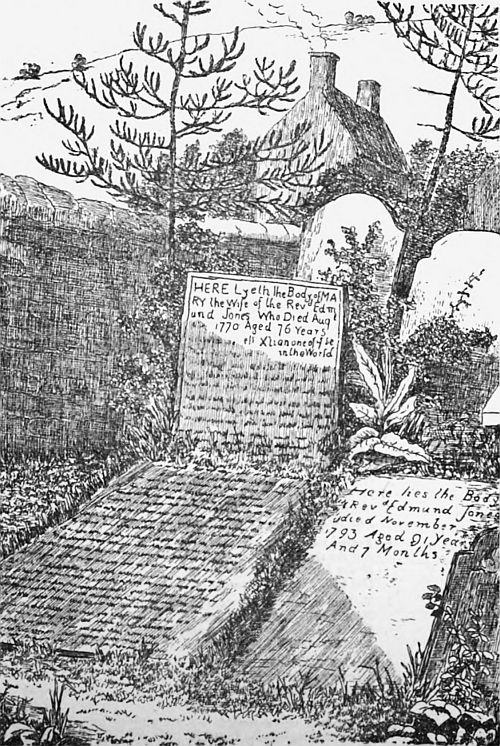
Most of what we can say about Mary Jones comes through what is recorded about her husband, the Reverend Edmund Jones (1702–93). One helpful source of information is a 2025 article titled “‘Original Memoirs of Apparitions & Spirits in Wales’ (c.1738): Publishing on the Supernatural in the Long Eighteenth Century,” written by Adam M. Coward and Martha McGill, and published in the academic journal Folklore. The authors tell us that the Joneses’ marriage was “an exemplary one” and Mary shared her husband’s stalwart faith. Coward and McGill also cite sources revealing that Mary was subject to a targeted haunting, to attacks from the Devil, and to divination while asleep or awake. One might assume that our ghost hunter was also what was termed a “ghost seer,” meaning she had special sensitivities to supernatural presences.
Edmund was an early folklorist with a particular interest in ghostly material, as shown in his A Relation of Apparitions of Spirits in the Principality of Wales (1780). (A smudgy but downloadable copy is at the Internet Archive while a clearer copy can be read online at the National Library of Wales.) Unfortunately, the tale of his wife’s encounter is not recorded there, and I suspect it rose after she had died.
The Jones-as-Ghost-Hunter Version
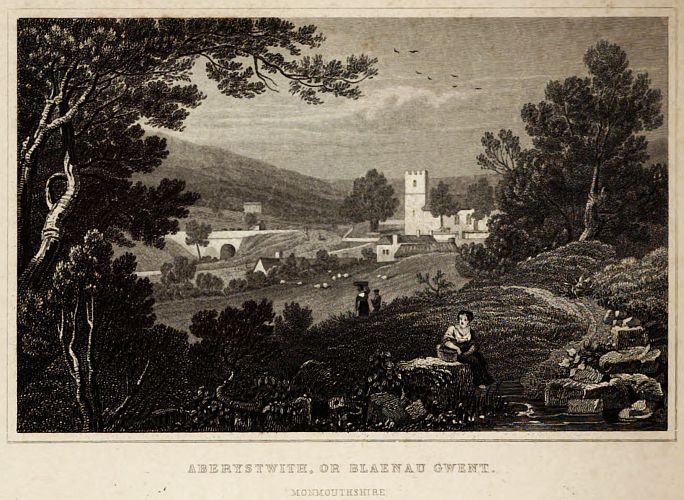
The Athenæum article presents Jones as a traditional ghost hunter. The tale opens with a setting that’s a good bit more specific than once upon a time: “About the middle of the last century … in one of the mountainous districts of Monmouthshire [Wales], called Blaenau Gwent….” The transcription continues:
About this time, there was in that neighbourhood an old mansion-house, a certain part of which had long been unoccupied, being haunted,—especially one particular room, in which no one who knew the place could ever be induced to sleep; and such strangers as had, in a case of emergency, been put into it, could not remain there on account of the supernatural disturbances to which they were subject. At length, Mrs. Edmund Jones, having repeatedly heard of this, paid a visit to the house and requested to be allowed to pass the night in this apartment.
In other words, Jones didn’t unknowingly stumble upon the haunted spot—no, she learned of it, went to it, and solicited permission to investigate it. Once there, she began her nocturnal surveillance of the room, remaining awake and alert while reading her Bible.
After a good long while, things started to happen. Jones then showed herself to be an unflappable paranormal investigator:
[S]he chanced to raise her head from the book, and to look up; when she beheld standing before her, on the opposite side of the table, a form of terrific aspect, with his eyes fixed fiercely on her. She fixed her eyes on him in return, and gazed upon him in the most composed and unconcerned manner. After they had remained for some time looking at each other, the demon spoke, and said, “Thy faith is in the candle.” “Thou lyest,” said she; and taking the candle out of the candlestick, she turned it down and extinguished it in the socket. Then, in the triumph of her faith, she folded her arms,—and continued in her seat, setting at defiance the powers of darkness.
In proving that her faith—her strength, her courage—did not vanish along with the candlelight, Jones performed the work of exorcism: “From that time forth, the house never suffered from ghostly molestations.” The tale becomes a religious parable illustrating that a strong faith can protect us from the evil things that lurk in the darkness, and it uses a standard ghost hunter framework to make that point.
The Jones-as-Waylaid-Guest Version
Jones herself actually existed, to be sure, but that we’re dealing with folklore instead of reliable history is confirmed by there being two other versions of this “faith in your candle” tale. Though it’s a fairly simple variation, the next version removes Jones’s status as a ghost hunter. Instead, it employs another familiar motif in ghost stories: a traveler or house guest spends the night in a room said to be haunted.
I found this version in J. Glyndwr Harris’s Edmund Jones: The Old Prophet (1987). Rather than solicit permission to probe a reported ghost, Jones finds herself stuck at a friend’s house due to stormy weather, her only choice of bedroom being one with a creepy reputation. We still see Jones’s courage in her response to the situation: “she was more ready to face the ghost than venture out into the storm.” Harris writes:
[Jones] told her friend that if she gave her a candle and a Bible she would have no fear of going into the spare room. So these were provided and she went to bed in the haunted room. In the early hours of the morning the ghost appeared in the guise of a decrepit old man. He made his ghostly way towards the bed and Mrs. Jones braced herself for the encounter. She remained calm and showed no fear. As he came near the ghost said, 'Woman, your faith is in that candle!' She was not put off her guard by his gibe and in an act of defiance she blew out the candle. The ghost disappeared and was never heard of again.
Unfortunately, Harris’s sources are left undocumented. Whether this tale comes from, say, a newspaper article or maybe a book, well, we don’t know. I like to think Harris heard it still being told at the local pub.
The Jones-as-Beer-Bringer Version
The final version I’ve found relocates the encounter to what’s probably its least spooky setting: the Joneses’ own cellar. Granted, in the 1700s, this would be a place where it’s practical to bring a candle, but the fear factor goes pretty flat when we learn that Jones goes downstairs to fetch a jug of beer rather than, let’s say, to investigate a series of unearthly moans. This variation appears in an article titled “Monmouthshire Apparitions,” printed in an 1882 issue of the magazine The Red Dragon:
It is told of Mrs. Jones that, going to the cellar one night for some beer, taking a candle to light her, she placed the jug beneath the tap and turned the key, but to her surprise there was no beer forthcoming; knowing the cask was nearly full, she looked up, and there, seated astride the cask, was the "foul fiend" himself in propria personæ. Nothing daunted at the sight, she coolly said in Welsh, "Oh, it's you who are there, is it?" "Yes," was the reply, "and your faith is in that candle." "You were always a liar," was her rejoinder, and she immediately blew the candle out. The devil, thus defied, gave in, and allowed the beer to run, and Mrs. Jones took it up in triumph for her husband's supper.
It would be tough to call this a ghost story. It’s more of a the Devil himself story. Yet it’s clearly the same basic narrative as the two above. It’s as if the storyteller wanted to put an original spin on the thing, but felt a need to retain 1) some setting that would allow for a candle, 2) a supernatural challenge to Jones’s faith, and 3) her coolheaded triumph over that challenge.
Jones Granted Honorary Mention
There are four other Ghost Hunter Hall of Fame inductees whose status there depends on legend rather than factual history: Athenodorus, Antoinette du Ligier de la Garde Deshoulières, John Ruddle, and Richard Dodge. These are people who we have very good reason to believe actually lived, but whose respective acts of snooping around a haunted site seem impossible to verify. Mary Jones might have taken a place beside them. She might have, if the legend about her paranormal investigation were not undermined by those two variations that push her away from being a ghost hunter as I’ve come to define it. What’s key here is an intentional and well-planned investigation of a reported haunting, not an encounter with a spirit resulting from an accident and being at the wrong place at the wrong time.
One of the primary goals of the Hall of Fame is to encourage paranormal investigators working today to discover and appreciate the rich heritage of which they are a part, and Jones’s story remains important to the legacy of ghost hunting. Therefore, unless more evidence pops up, I am pleased to award Honorary Mention to the ever-resolute, ever-faithful Mary Jones.

 BROM BONES BOOKS