Explanations Natural and Paranormal
Ghost lights are fairly common among railroad hauntings, and one of the most famous has been witnessed along the abandoned tracks near Gurdon, Arkansas. There are a couple of natural explanations for the phenomenon: it might be swamp gas, or it might be something called the “piezoelectric effect.” The latter is explained in a short piece about the Gurdon ghost light at Atlas Obscura: “Piezoelectricity is generated by materials such as certain ceramics and crystals, which when bent or squeezed generate electricity and sparks.” One might suppose a study testing this possibility would have been conducted, but if so, I haven’t found anything about it. Show me the squished crystals!
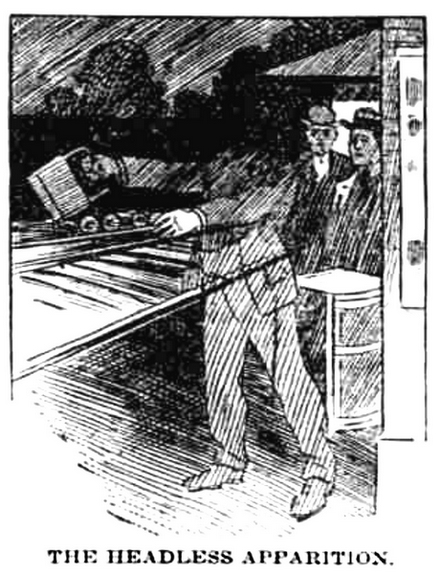
There are also a few backstories explaining the light as paranormal, and two of these certainly make the case a railroad haunting. The first involves a man who was beheaded by a train, and the second concerns a railroad worker who murdered his foreman. I searched online archives to see what I could see regarding both.
A Crossing Casualty in Search of His Head
Perhaps the best account of the headless ghost explanation is found in Melissa Calley’s “Ghost Lights,” a short article in An Arkansas Folklore Sourcebook (1992). Specifying the haunted site as Sandy Crossing, Calley transcribes the tale told by a Gurdon resident (and presumably her relative, given the surname). Once upon a time, there was a man who “got run over at that crossing there one time, and it cut off his head.” Locals of the time never found the victim’s head, so they buried what they could. Afterwards, there were reports “that his ghost comes back looking for his head,” and the mysterious light is a lantern used in the search.
I wasn’t able to find any newspaper articles about a train-related beheading in the area. The closest I found was a 1949 report about a man who died on the tracks near Gurdon after having “fallen asleep on the railroad track,” which I have a hunch was a kind way of saying he committed suicide. Suicide often stirs up reports of ghostly activity, but this tragedy feels a bit too late to account for the lore surrounding the Gurdon Light—especially if the phenomenon began in the early 1930s, a point I’ll return to in a moment. Forgive my unkind way of saying it, but my efforts to trace this explanation for the haunting led to a dead end.
A Murder on the Tracks
The online Encyclopedia of Arkansas offers this rendition of the second paranormal explanation:
Many trace the Gurdon Light legend to a murder that took place near the railroad tracks in December 1931. William McClain, a foreman with the Missouri-Pacific railroad, was involved in an argument with one of his employees, Louis McBride, regarding how many days McBride was being allowed to work. During the Depression, the company did not have the option of giving McBride more hours on the job. McBride became very angry, hit McClain on the head with a shovel, and beat him to death with a railroad spike maul or a spike hammer. The Gurdon Light was first sighted shortly after this murder, and many have come to believe that the light is actually McClain’s ghostly lantern glowing.
Now, that’s enough detail—a date, a motive, names of both murderer and murdered—to assume there would have been newspaper coverage! First, I made sure the Missouri-Pacific was among the many railroad companies connecting in Gurdon, which had served as a transportation hub. While I couldn’t find anything about the murder at the newspaper archives of either the Library of Congress or Google, Jennifer Jones provides a useful image of an Arkansas Gazette article at her The Dead History site. Also, I have no reason to doubt the quotations of the Southern Standard provided in this anonymous document titled “The Gurdon Light.”
I do worry, though, about one claim made in that document: “Shortly after that time, area residents began to see the light nearby.” I found this said elsewhere, too, but never with any evidence to substantiate it. I gave it a go myself, but as yet I haven’t found anything to put a date to the first observations of the ghost light. Sightings certainly might have begun in the early 1930s, but I would be grateful for assistance in confirming this.
Visiting the Haunting Today
A post at the Arkansas State Archives places the haunting “along the path of the old railroad track about four miles north of Gurdon and about two miles away from Interstate 30.” Comments at the Roadside America site provide more details and warn of the dangers involved. Please be very careful if you decide to investigate.
Gurdon is a small town, but it’s roughly halfway between two cities that have their share of haunted sites: Little Rock and Shreveport. If you plan a ghost-hunting tour that includes the Gurdon Light, please let us know about your experiences in the comments section below.
Discover more “Railroad Hauntings You Can Still Visit” at the page for
After the End of the Line: Railroad Hauntings in Literature and Lore.