As the enraptured Ichabod...rolled his great green eyes over the fat meadow lands, the rich fields of wheat, of rye, of buckwheat, and Indian corn, and the orchards burdened with ruddy fruit, which surrounded the warm tenement of Van Tassel, his heart yearned after the damsel who was to inherit these domains, and his imagination expanded with the idea, how they might be readily turned into cash, and the money invested in immense tracts of wild land, and shingle palaces in the wilderness. Nay, his busy fancy already realized his hopes, and presented to him the blooming Katrina, with a whole family of children, mounted on the top of a wagon loaded with household trumpery, with pots and kettles dangling beneath; and he beheld himself bestriding a pacing mare, with a colt at her heels, setting out for Kentucky, Tennessee,—or the Lord knows where!
— Washington Irving, “The Legend of Sleepy Hollow“
Sherlock Crane Is Converted
It’s hard to say if Sleepy Hollow (1999), directed by Tim Burton, has done more to help or to harm a general appreciation of Washington Irving’s popular tale. On the one hand, the movie reminds a vast number of people about the original story and hopefully inspires some of them to read or reread that piece of literary fiction. On the other, the movie radically revises the original, transforming Ichabod Crane into a precursor of Sherlock Holmes and giving him a case that converts him into an occult detective. It’s possible a number of viewers are convinced these profound alterations are “how the story goes,” and that would be sad.
No, there isn’t a murder mystery lurking behind the appearance of the Headless Horseman in the original. No, Ichabod doesn’t arrive in Sleepy Hollow to solve it. No, the decapitated demon isn’t proven to be real. No, Ichabod doesn’t abandon his skepticism to accept the reality of the supernatural. And no, Ichabod doesn’t win the heart of Katrina Van Tassel along the way.
Sleepy Hollow introduces so many changes that it’s probably better described as “inspired by” rather than “adapted from” Irving’s tale. But that might be exactly what makes it a pretty good, entertaining movie.
Some Interesting Changes and a Very Disagreeable One
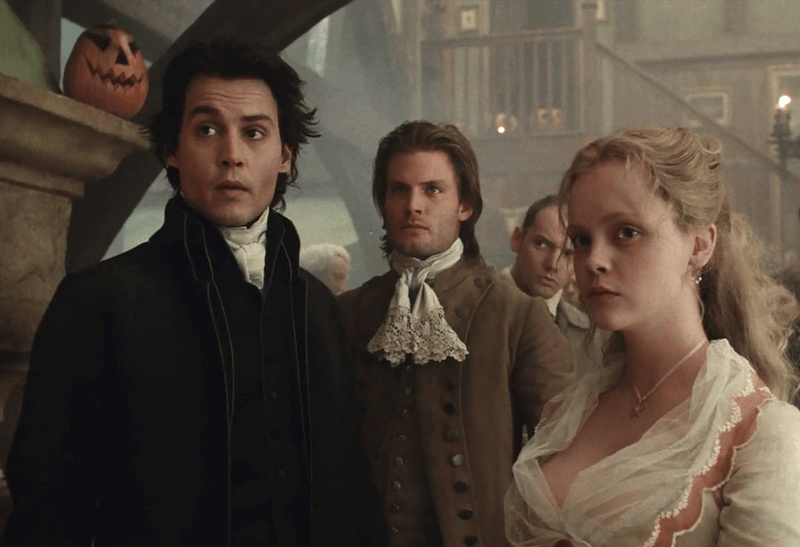
To appreciate Sleepy Hollow, one should abandon Irving and see the story as belonging to an entirely different narrative genre. For instance, one might see it as something close to folk horror, albeit far lighter and more comic than typical for that tradition. Sleepy Hollow follows the basic template of The Wicker Man (1973): a detective travels to place isolated enough that the Old Ways are still embraced. However, while the 1973 film never leads the detective to unearth supernatural forces, the Burton film does. This is regard, it comes closer to Angel Heart (1987)—a detective film that the critics at Folk ‘n’ Hell classify as “folk horror adjacent at the very least, and arguably folk horror by inversion“—or to Apostle (2018), which is more recognizably folk horror but with a protagonist who isn’t a detective in the professional sense. Within these parameters, Sleepy Hollow is distinctive, interesting, and pretty fun.
One change to Irving introduced by Sleepy Hollow with which I struggle, though, is turning Crane into a romantic lead. To be sure, Hollywood rarely asks audience to spend an hour and 45 minutes wincing at a character as narrow-shouldered, lanky-limbed, glassy-eyed, and snipe-nosed as Irving describes the character. Better to cast Johnny Depp. What I struggle with is tossing out what my epigraph reveals: Irving’s Ichabod sees Katrina as little more than a financial means to start a fruitful life on what was then the western frontier. I struggle to set aside that Ichabod Crane is not very likeable! I see him as a far milder version of Macbeth or Dracula or even pre-redeemed Scrooge in that I’m certainly interested in the character’s story, but I sure don’t want to go have a beer with him.

Now, Christina Ricci comes much closer to Irving’s descriptions of the young and pretty Katrina. But I struggle to forget that she’s suppoooosed to marry Brom Bones! Irving tells us early on that, regarding Brom’s courtship of Katrina, “it was whispered that she did not altogether discourage his hopes.” At the end, we read that Brom “conducted the blooming Katrina in triumph to the altar.” Instead, Burton’s Katrina ends up with Ichabod, and shortly after Brom’s death (yes, you heard me: Brom Bones dies roughly halfway through the film!), she says this:
I have shed my tears for Brom, and yet my heart is not broken. Do you think me wicked?
Clearly, Andrew Kevin Walker, the screenwriter, wants only to hurt me. And I’m giving you the side-eye, too, Tim Burton!
Despite His Early Death, Brom Bones Is Brom Bonesy
I’m pleased to say that the film’s Brom Bones (played by Casper Van Dien) is presented in a way that’s fairly true to Irving’s character. At least, he is for the time he remains alive. Most film adaptations conclude with Ichabod fleeing from what he believes is the Horseman, leaving Brom free to marry Katrina. They play with Irving’s strong suggestion that Brom was masquerading as the ghost. Sleepy Hollow bumps up this scene to about the 30-minute mark, using it as an example of Brom playing pranks on Ichabod. Brom pranking the snooty newbie is well in keeping with the original tale.
In addition, Irving’s Brom is “always ready for either a fight or a frolick,” and in the movie, the character shows his readiness for the former by coming face-to-uhm—let’s say, sword-to-hand-sickles with the real headless ghost. Here, Brom proves himself to be fearless to the point of self-sacrifice. He shows that, despite his boyish love of making mischief, he is a strong and brave man.
And he dies proving that.
My purpose for exploring these screen versions of Brom Bones is to chart his evolution from Irving’s “hero of the country round” into depictions that make him hardly admirable and downright bullyish. Even with all of its departures from the original source, Sleepy Hollow does not add to those contortions of Brom.

