In Search of Smoky Hill
I’ve been trying to push west with the U.S. entries in this series, traveling to Montana and Utah with recent hauntings. This case doesn’t take us quite that far, but it was reported in Denver’s The Rocky Mountain News on May 21, 1879. The ghost was spotted on the Kansas Pacific Railway, which ran the breadth of Kansas and well into Colorado. While we can narrow the haunted site to those states, I struggled to pinpoint it any further. At first.
Here’s what I had to work with in the article itself. After a few words to appease skeptical readers, the reporter says:
It is said upon what appears to be pretty good authority that Smoky Hill, on the Kansas Pacific railroad, is haunted by a ghost....[T]he engineers say that, crowning the summit of Smoky Hill of moon-lit nights a female form often startles the engineer of approaching trains. Sometimes it comes walking down the long reach of track, to all appearances a veritable woman, in flesh and blood, but when the train is almost upon her, and the engineer’s hair is standing on end with terror, and he 'down’s brakes' to avoid a tragedy, the form disappears in mist, and nothing more is seen of it. As all this happens on a treeless plain—miles away from any habitation—and the phantom invariably disappears in the full blaze of moonlight, it must be confessed that the thing looks as if it was referrable to the inexpiable agencies of the world of spirits.
We’re given some clues as to the location here. First, we seem to be dealing with an actual hill, one with a summit that rises on an isolated “treeless plain.” Later on, the article says “a family was murdered there,” so it’s a specific spot.
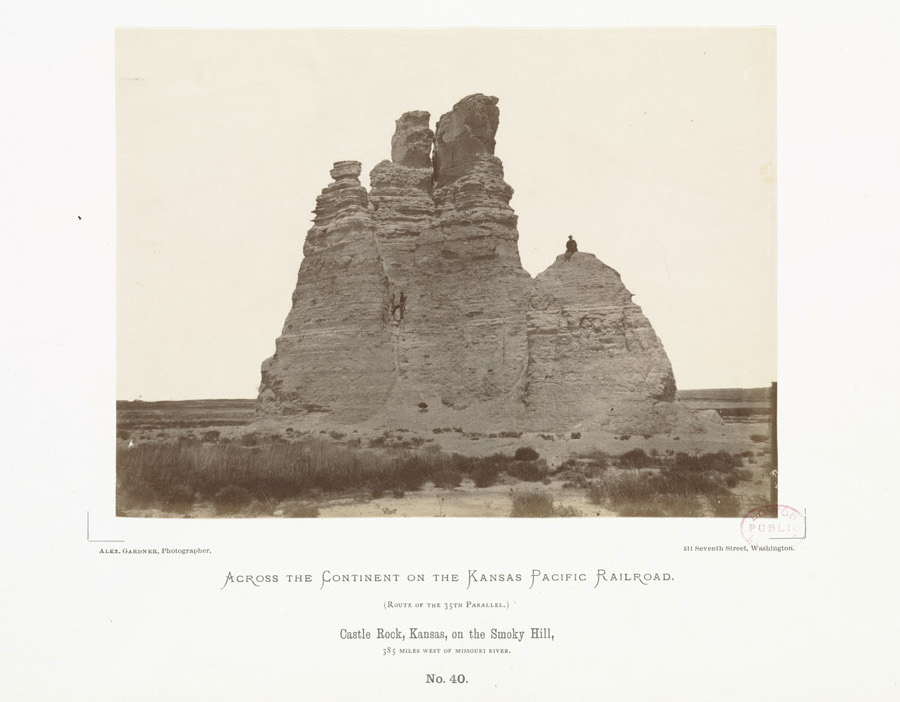
Unfortunately, my initial research led, not to one specific hill, but to the Smoky Hill River, to the Smoky Hill Trail, to the Smoky Hill Chalk (a.k.a. the Smoky Hill Chalk Member), and to the Smoky Hills (plural). Fortunately, I came upon this photograph from Alex Gardener’s Across the Continent on the Kansas Pacific Railroad (c. 1869), and it places an outcropping called Castle Rock “on the Smoky Hill.” Needless to say, Castle Rock hasn’t gone anywhere. It’s safely in Kansas, not far from a town called Quinter.
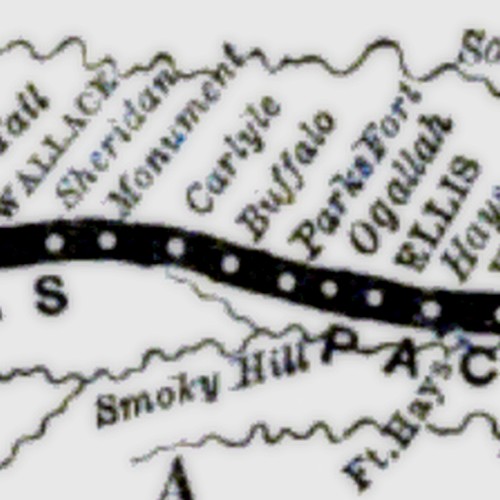
This, then, told me where to look on an 1875 timetable for the Kansas Pacific. An accompanying map of the route also refers to the area as Smoky Hill. With this, we can see that the multiple trainmen who witnessed the phantom woman, as mentioned in the 1879 ghost report, were very likely making their way along these stops: Ellis, Ogallah, Parks Fort, Buffalo, Carlyle, Monument, and Sheridan.
Unfortunately, I can’t zoom in on the haunted site any more than that. But this is certainly better than some undesignated spot in Kansas or Colorado.
A Possible Inspiration for the Haunting
That ghost report doesn’t do much at all to help identify who the ghost might have been in life. “Some years before,” the reporter says, “an emigrant family was murdered there by Indians,” and it’s uncertain if “the uneasy spirit is one of the nameless victims….” But why would such a victim follow the tracks? One might wonder whether the ghost originates with an actual person or is more a manifestation of a general anxiety stirred by the brutal clash between the indigenous people and the encroaching white settlers. In other words, did anyone crossing that lonely stretch of tracks see a psychological mirage shaped by the very real threat of death?
In the back of those engineers’ minds might have been the story of the Germain family, who had stopped at Sleepy Hill on a trek west from Georgia. There, they clashed with a group of Cheyenne riders. In the December 1, 1874, issue of the Daily Commercial, a paper printed in Leavenworth, Kansas, a journalist describes two girls returned from captivity about three months after the attack. (This report and others related to it can be accessed through the Newspapers.com Open Access Portal at the Kansas Historical Society’s website. Be warned that these articles use the colonists’ racist language when addressing the indigenous groups.)
Regarding the Germains, the reporter says:
They encamped one night on the Smoky Hill, not far from Sheridan Station, and while at rest were surprised and attacked by a band of Cheyenne Indians. Of the nine members of the family, five were instantly murdered and four carried into captivity.
The father, the mother, an infant, the only son, and one of five daughters were killed. The other four daughters were taken hostage. I suppose we might wonder about the ghost being that violently killed mother or daughter, but that’s very iffy. I mention this tragedy more to illustrate the historical context of the case and to clarify what I mean by the spectral figure being a manifestation of the trainmen’s anxiety. Working on the railroads, after all, came with a variety of deadly dangers, and there were even more with Westward Expansion.
Visiting the Site Today
Compare the 1875 timetable/map linked above to an online map, and you’ll see that Ellis, Ogallah, and Monument are still there. However, the other stops seem to have disappeared. WaKeeny, Collyer, Quinter, and a few other towns have since appeared along the old Kansas Pacific line—the path of which still has tracks. Exploring those tracks at night is far from wise, but Interstate 70 and especially Old Highway 40 follow them pretty closely. Interested paranormal investigators might rely on their cars to see if the “veritable woman” who turns to mist remains after 150 years.
If you do so, by car or by foot and regardless of the results, please share your experience in the comments below.
Discover more “Railroad Hauntings You Can Still Visit” at the page for
After the End of the Line: Railroad Hauntings in Literature and Lore.