Drowning in My Metaphor
There’s no way to measure it, I suppose. Still, I’d be willing to bet that, when Arthur Conan Doyle’s Sherlock Holmes adventures were first introduced to readers, the Great Detective gained more popularity than Harry Potter back when people formed midnight lines at bookstores for the release of J.K. Rowling’s next novel. A blasphemous claim to some, but I base it on how very often I see Doyle’s detective named in print—usually with no explanation of who he is because no explanation was needed—between 1887 and 1927, the years the Holmes canon debuted.
Holmes’ initial tidal wave of success inspired a crowded beach of other writers to dive into the waters of mystery solving. Those sleuths bobbing above the surface include Pirkis’ Loveday Brooke (1894), Freeman’s Dr. Thorndyke (1907), Chesterton’s Father Brown (1910), Christie’s Hercule Poirot (1920), and Sayers’ Lord Peter Whimsey (1923).
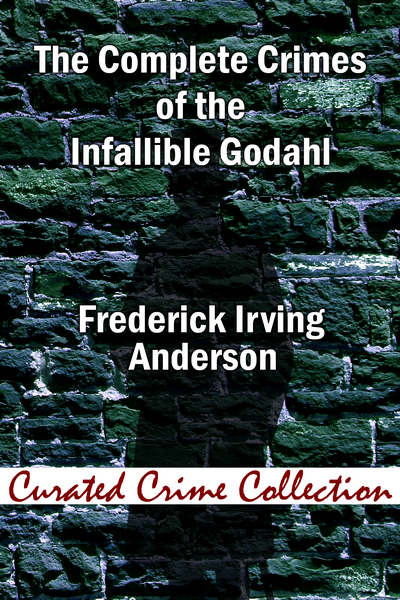
But there was a smaller wave, too, of fiction focused on a central criminal rather than a central detective. The best of this criminal undercurrent make up the Curated Crime Collection, and the penultimate volume is now available. It’s The Complete Crimes of the Infallible Godahl, by Frederick Irving Anderson.
Now, I certainly cherish the “Partners in Crime” volumes that make up about half of the Collection. After all, two great books for the price of one certainly has its charms. However, I also have a special fondness for the “Complete Crimes” books. Take, for instance, The Complete Crimes of the Burglar’s Club. As far as I know, Brom Bones Books is the first press to combine all eighteen of Henry A. Hering’s tales about the title felonious fraternity. Likewise, in the most recent volume, I include the novella that ended Anderson’s Infallible Godahl series when it first ran in magazine form. However, that longer final work, clearly part of the series, was not included when the first six stories were collected as a book in 1914. This raises a curious question.
Why Wasn’t the Novella Included in the 1914 Collection?
By 1914, authors and publishers had settled into a rough pattern. In fact, it explains why only the first twelve of Hering’s Burglars’ Club tales were collected and reprinted in 1906. The pattern is this:
- A serial of six short stories involving a single character/group/world debuts in a magazine.
- If popular, another six stories are solicited, written, and run.
- Those twelve stories are then collected in a nice-sized book.
Anderson winks at this pattern in his first tale. Describing successful author Oliver Armiston and his greatest creation, Anderson says:
The serial rights telling of the exploits of this Godahl had paid [Armiston] handsomely. The books of Godahl's adventures had paid him even better, and had furnished him yearly with a never-failing income, like government bonds, but at a much higher rate of interest.
Perhaps Anderson himself wanted to try stretch the magazine-serial-to-book-collection pattern a bit. He wrote six short stories involving the Infallible Godahl, and these were published in The Saturday Evening Post. Rather than another six, though, he wrote a novella, one that’s about as long as six stories, and the Post also ran this in segments. As I say, the novella is obviously part of the series! Along with Godahl himself, other characters introduced in the sixth short story return to play key roles in it.
Nonetheless, the 1914 book version leaves out the novella and presents only those six shorter tales, making for a fairly skimpy book. Was the idea of combining short stories with a novella simply too new? It doesn’t strike me as terribly radical or revolutionary, but I say this over a century later. I’m stumped. I have no solution to this mystery. All I know is: you can now read all of Anderson’s Infallible Godahl adventures in a single volume. I hope the author’s ghost is happy about this. I bet he’s chuckling over the fact that I’m unable to solve the next mystery, too.
Who Is the Infallible Godahl?
Think of Stephen King’s novel The Dark Half (1989). There, a writer using a pen name decides to “kill off” that pseudonymous persona, as if Samuel Clemens had had quite enough of Mark Twain. But, in King’s story, that pseudonymous persona objects to being erased. The entity created by the pen name comes to life and misbehaves in ways one might expect from a Stephen King novel. Anderson plays with something along these lines. Sort of.
In the first story, titled “The Infallible Godahl,” Anderson introduces us to Armiston, the author, and to Godahl, the author’s imaginary master thief. But then a master thief steps into the shoes of Godahl, bringing the imaginary criminal to life.
And that’s all well and good for the first story. However, a master thief going by the name Godahl then appears in the remaining short stories and the novella. And Anderson never explains who this Godahl is! Here are some possibilities:
- We’ve “gone back” to read those tales that had made Armiston a successful author.
- We’re “moving forward” with the master thief who has stolen the name of Armiston’s character.
- Lo and behold! It’s Armiston himself committing those later crimes!
If Anderson wanted us to think we’re reading Armiston’s tales, it seems like he’d put them before the others. That way, we’d have gotten to know Godahl, but—surprise surprise!—he’s been a fictional creation all along, one that inspires a real-life crime. Meh. Personally, I’d find this a bit awkward and disappointing even if Anderson had rearranged the order.
I’m more inclined to think we’re reading the crimes of someone who has adopted the name of that imaginary thief. It does raise questions, though. How did he become internationally known under that borrowed name? Why does no one mention that he shares the name of a famous fictional criminal? It’s a bit like meeting someone named Moriarty and not making a joke about that person being “the Napoleon of crime.”
The notion that Armiston moonlights as Godahl, getting away with crimes as clever and complex as those he puts to paper, is certainly intriguing. I’d have to think more about this, but I’m sure it raises plenty of questions, too.
The really fun thing is: Anderson never unravels this for us. In addition, what might be called The Plasticity of Identity becomes a major motif in the collection. Like many other thieves in the Curated Crime Collection, Godahl uses disguise, but Anderson plays with disguises designed to perfectly imitate known people. In other words, he suggests that we can’t ever really know anyone at all, not with 100% certainty. This puts The Complete Crimes of the Infallible Godahl among the smartest volumes in the Curated Crime Collection. Read more about it here.


