Separating Fiction from Fact
I’ve now read enough of what Catherine Crowe called her Tales of Continental Jurisprudence to have moved them to a separate section at the bottom of my bibliography of her short fiction. After all, they’re not short fiction. They’re short true crime.
However, they also illustrate Crowe’s skills as a narrator working in what might be called “single-sitting” or “article-length” pieces. In fact, I found “Antoine Mingrat,” later titled “The Priest of St. Quentin,” to be one of Crowe’s best entries in the series. This is partly because the case itself is fairly straightforward while some of the others stretch the short form in terms of complexity and of the number of names readers must remember. In addition, Crowe tries a couple of new storytelling techniques here to put readers into the mind of a murderer.
The case involves the presumed rape and certain murder of Marie Guérin, crimes traced to Antoine Mingrat, a priest in the northern France village of Saint-Quentin. Before Crowe’s version, the 1822 French crime had been presented to English readers in an 1833 series titled “Celebrated Trials of the Nineteenth Century,” run in Fraser’s Magazine. This earlier chronicle focuses much more on Mingrat’s background than Crowe’s, and I have a hunch that her source might have been an earlier French one.
In the Shoes of a Murderer
In brief, the case concerns the power-hungry Mingrat. The 28-year-old clergyman was “gifted with uncommon bodily strength” while burdened with a repugnant face, Crowe explaining that “his complexion was sallow, his eye malicious, his smile treacherous.” His preaching was similarly objectionable: “zealous overmuch; reproving harshly; inflicting severe penances; and magnifying small faults into great sins.” Looking and behaving as a fiend, Mingrat proved himself to be exactly that.
Marie Guérin was a member of his congregation, one both pious and beautiful. Through a bit of conniving, the priest subjected the woman to kidnapping, rape (implied when Mingrat’s servant stands outside his bedchamber and hears “heavy sighs from within, as of one very sick or in the agonies of death”), and finally murder.
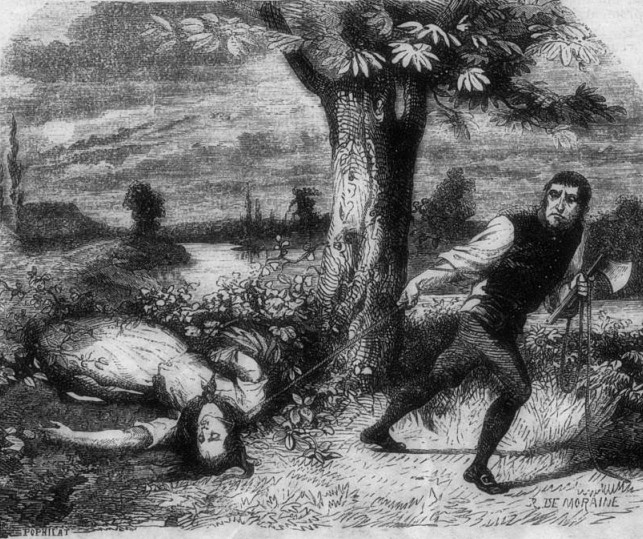
The tale then follows the tribulations of Mingrat as he hauls Guérin’s body to a far-away spot in the hope of making the murder look like suicide. This is when Crowe uses a couple of unexpected and interesting narrative techniques. First, she bids readers to contrast—not Guérin’s horrific experience—but the difficulties faced by Mingrat to her readers’ lives. And her own! She writes:
And now imagine his situation! Let us picture to ourselves the murderer as he stood on that lonely hill, scantily sprinkled with thorn bushes and withered nut trees; battered by the storm, for the rain fell and the wind raged furiously on that awful night; before him the steep ascent that he could not surmount; beside him the body that he could not get rid of! Conceive his horror, his anguish, his despair! For myself, I could not, on hearing this fearful story, help endeavouring to recall the fearful drama; bringing back to my memory that May of 1822; contrasting situations—my peaceful chamber, my calm sleep, and my cheerful waking. I felt ready to fall upon my knees, and bless God that I had been exempted from such trials.
Hey, here’s a curious thing. Crowe married in 1822, so that year would have held special meaning to her. By 1846, the year this piece debuted in print, she had separated from her husband, presumably due to be the marriage being unhappy and possibly abusive. Perhaps this interesting autobiographical moment was her way of saying to herself: “Well, things could’ve been worse. A lot worse.”
A few pages later, Crowe uses a second technique to put readers into the mind of the murderer. Mingrat has made it back home with no one seeing him dispose of the body. Then the author suddenly shifts to the present tense:
But suddenly he pauses—his whole frame is relaxed—his visage, inflamed by the torture of his mind and his vehement labours, is overspread with a ghastly pallor—what is it that affrights him so? Is there a noise without, or has he discerned some human eye watching him through an unguarded chink? Why does he fling down the hatchet, and thrust his hands wildly into his pockets, and then rush frantically from the house?
It only lasts a single paragraph, then we’re back to the conventional past tense. On the one hand, Crowe is putting readers into the murderer’s shoes to teach the lesson that crime takes a terrible toll. On the other, these unexpected narrative touches make this piece a bit more personal and a bit more creative than the other Tales of Continental Jurisprudence I’ve read so far.
As I explore these pieces, I wonder if Crowe had been working toward eventually completing enough to fill a volume, a sort of rogues’ gallery in prose. Alexandre Dumas had done something similar with his multi-volume Celebrated Crimes (1839-1841). This and the series in Fraser’s mentioned above shows there was an audience for true crime. However, the number of Crowe’s criminal biographies—or I should say the number I’ve identified so far—would have made for a fairly slim book. And slim books were rare birds in the mid-1800s.
Maybe she decided to shift her focus towards other kinds of writing.