Despite My Strong Interest
I have an enduring interest in Catherine Crowe (1790-1872), the versatile Victorian author whose work has drawn growing attention among literary scholars in recent years. Since her novels and non-fiction books seem to dominate the scholarly discussion, I’ve opted to explore her short fiction. I’ve also joined the desperate quest to locate a portrait of this once-famous figure, one from her lifetime. The best I’ve found is a caricature of dubious accuracy.
Though Crowe was inducted to my Ghost Hunter Hall of Fame quite some time ago, I’ve dilly-dallied in writing a more detailed post about why she’s there. It’s high time I do so. Unfortunately, the only detailed chronicle of her involvement in a ghost hunt seems to be her own account of it. (It joins thirteen other chronicles in The Victorian Ghost Hunter’s Casebook.) I’ve searched for additional sources, perhaps a newspaper report about the site said to be haunted, but no luck so far.
Nonetheless, Crowe’s narration of the investigation provides a few clues that might lead to more information. That’s my goal here: to carefully comb through that single document for useful details about the case.
What We Know
Crowe says she learned of an alleged haunting from a lawyer who was in charge of the house. For years, its reputation for being “troubled” had prevented it from being rented or sold. She says surprisingly little about what manifestations led to the house’s bad reputation. About the best we get is: “unaccountable lights were amongst the things complained of.” However, we do learn that a hot spot was “the back parlor, which [the lawyer] had heard from the different inhabitants was the room in which they had met with most annoyance.” Crowe’s knowledge of the case, we see, is limited to what the lawyer knows.
Despite that sketchiness regarding why the house was deemed haunted, or maybe because of it, Crowe assembled an investigative team. It was comprised of the following:
- Crowe herself;
- the lawyer, who she identifies only as “Mr. Mc. N.”;
- a person who Crowe explains is “a young girl who was easily mesmerised, and when in that state a good clairvoyante”; and
- two other men she describes as “some gentlemen of my acquaintance—very eminent men, with honest, inquiring minds.”
Regarding the house itself, Crowe writes:
It was a small house, in no respect different from the others in the street. They seemed all of the same description. A narrow frontage, with one window and the door, on the ground floor; two windows above; two rooms on a floor, three stories in height, and a kitchen, scullery, and cellars underground.
We see it’s not an isolated cottage in a rural hamlet. Indeed, toward the end of her account, Crowe mentions “an inhabitant of the same city.” City. Not village or even town. Are we dealing with tenements or colony houses in an urban or suburban neighborhood?
The Night’s Results
I think Crowe is being modest when she says the investigation “resulted in almost nothing.” At one point, the team heard “a metallic sound at the door, which was ajar, like the striking of two pieces of iron. We all heard it, but could not say what occasioned it.” Granted, that could’ve been some ordinary noise caused by five people tromping around a house that had been empty for months or years. More dramatically, once the clairvoyant had been hypnotized, she claimed that two murders had been committed there. She clarified that the crimes had occurred in “a very old house,” which was “not exactly on the same ground, but the room we were in was on part of it.” An adjacent or overlapping haunting? Interesting.
Furthermore, the clairvoyant spotted waves of light! The others seemed unable to see them at first, but when Crowe grasped the psychic woman’s hand, she also “saw thrown up, apparently from the floor, waves of white light, faint, but perfectly distinct and visible.” Moments later, Crowe spotted another, brighter light she describes as “like an extremely vivid spark, only not the colour of fire; it was white, brilliant, and quiescent, but shed no rays.” Not even the clairvoyant spoke about seeing this second light.
As the investigation drew to a close, the lawyer revealed that he, too, had seen both lights, and he had done so without holding hands with the psychic! The other two men hadn’t seen any lights at all. What made the lawyer able to do so? Well, Crowe establishes at the very start of her narrative that Mc. N. is very likely a “ghost-seer.” Not long after the 1848 publication of The Night-Side of Nature, Crowe’s bestselling collection of “true” ghost stories, the lawyer had sent her a sort of fan letter, sharing his own weird experience. Though he was away from his family at the time, Mc. N. had witnessed the figure of his father at the moment of death. It’s something now called a crisis apparition, and Mc. N. might have been what we now term a sensitive. This explains why he saw those lights without assistance.
When Did the Investigation Occur?
Crowe provides clues to narrow down when the investigation took place. Clearly, it was sometime after 1848, when Night-Side debuted, and before 1859, when Crowe’s narrative appeared in Ghosts and Family Legends. In that introductory letter about his crisis apparition, the lawyer also mentioned the haunted house, and the case was new to Crowe at the time. She says that she hadn’t organized the investigation until “as much as six or seven years after I had first heard of this house.” Is it safe to date the ghost hunt at 1854 or 1855? Probably no later than 1858.
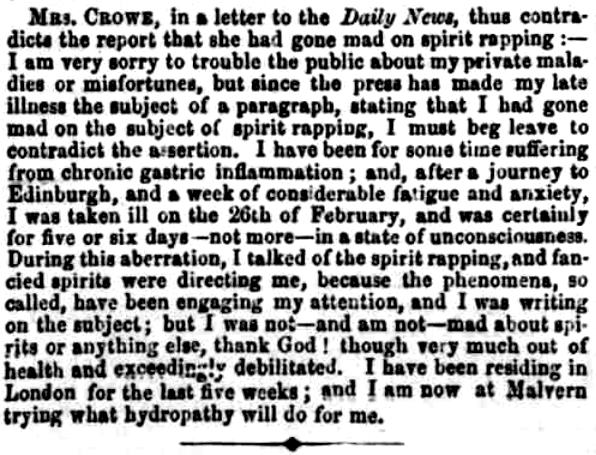
This means the investigation happened about the time, or not long after, Crowe had suffered some kind of breakdown in Edinburgh, the city where she then resided. In fact, according to Lucy Sussex, Geoffrey Larkin links what certainly looks like Crowe’s investigation to the breakdown itself. Sussex says: “Larken notes that the incident was probably triggered by stress, ill-health, and a night spent with five others, including a clairvoyant, in an Edinburgh haunted house” (pg. 103). Unfortunately, Larken’s research was never published, so I’m unable to see his evidence or reasoning supporting the claim that the ghost hunt contributed to the breakdown.
Did the Investigation Happen in Edinburgh?
To determine where the investigation was held, I hope I’m not reading too much into her use of “home” in this line:
I was often absent from home at this time, but for the next two or three years [after receiving Mr. Mc. N.'s letter] I sometimes met him and inquired about the house.
We’ve seen the house was probably in a city. Despite scant information about alleged manifestations, Crowe went ahead organized an investigation of it, implying the ghost hunt was a bit of a lark and probably not too far away. In fact, she never mentions traveling far to get there. There’s a certain logic in assuming the house was in or close to Edinburgh.
At least to date, I’ve found no reports of a haunted house in the Edinburgh area in the early to mid-1850s. Nor have I found any evidence of a ghost hunt occurring in Auld Reekie between 1854 and 1858. The latter becomes particularly frustrating when we see that Crowe says her team’s outing made its way into the public eye:
Our expedition was to be kept a profound secret; and it was so, till some time afterwards, when, like most other secrets, it got wind and it spread abroad.
Do I need to redirect my search? I’m convinced the truth is out there, be it in some record of the house’s ghostly notoriety or in an alternate account of Crowe’s investigation. We’ve got leads. We just need to pursue them.
EVIDENCE CROWE WENT ON MORE THAN ONE GHOST HUNT