
Before Houdini Squinted at Séances
Walter F. Brooke was the stage and pen name of F. W. Hanscombe (?-1909). He was primarily an actor, but he became associated with a very successful magic act, and at some point, he began investigating—and regularly debunking—sites alleged to be haunted. In this regard, he put a unique spin on the practice of magicians who applied their knowledge of trickery to defrauding Spiritualist mediums. And this practice was established well before Harry Houdini joined the gang of showbiz skeptics.
For years, Brooke shared the spotlight with John Maskelyne and George Cooke, who had achieved fame in England as illusionists in the late-1800s. “Messrs. Maskelyne & Cooke” started out as Cheltenham tradesmen who dabbled in magic tricks during their spare time. When the Davenport Brothers came to town at least implying to have powers over supernatural forces, the Brit duo went to work unmasking the Yank duo. Maskelyne and Cooke reproduced the wonders they had seen in the Davenports’ performance, assuring the audience that there was nothing otherworldly involved. It launched their new careers. (There’s more information on Maskelyne & Cooke here, here, and here.)
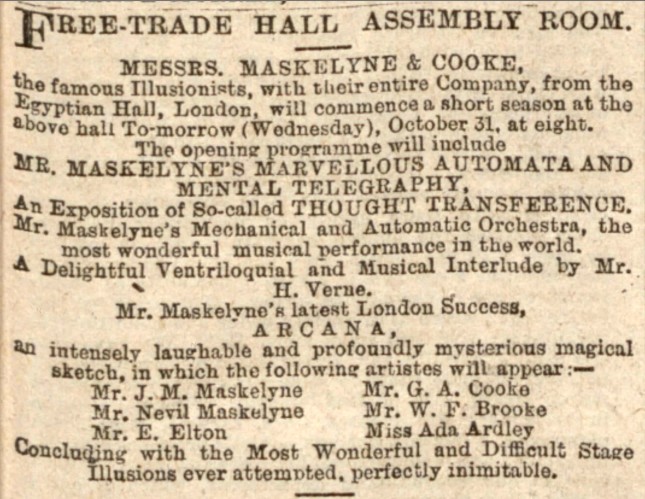
It’s easy to assume that Brooke was inspired by Maskelyne and Cooke to redirect professional debunking away from séances and toward spooks. After all, one could make a name for oneself. One might even make a few quid in the process.
“Putting a Stop to All Seemingly Unaccountable Shrieks”
A very curious circular was reprinted in the December 14, 1892, issue of the Pall Mall Gazette:
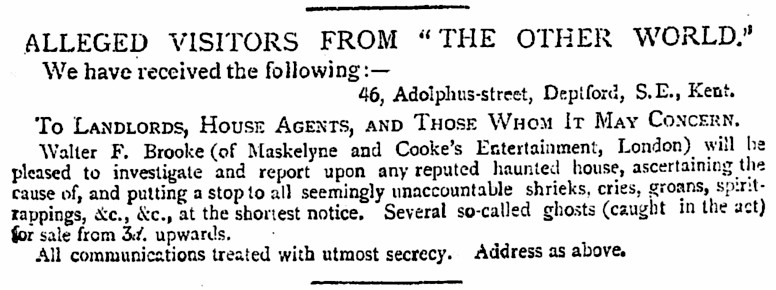
In a follow-up interview published on the 19th, Pall Mall readers were informed that Brooke already had experience with pulling the sheets off suspected ghosts. Having traced mysterious sounds to a stowaway pig in a ship’s hold and to a disconsolate cat with its head caught in a lobster tin—and to creaky floorboards and to leaky gutters—Brooke claims to “have never been beaten.” This isn’t to say his job has always been an easy one:
One house I visited bore a very bad name. Unearthly shrieks as of a woman while being ill-treated had been heard by the neighbours, as well as by the late occupants. I stayed in the house by myself one evening, but failed to hear anything out of the common, until a lady, a few minutes before twelve, gave me a taste of her quality. I heard her as I was sitting in the kitchen, and then in the room above; I went into the garden—she was there; I went into the street—she was there. I know she was there, because I heard her. I examined the house thoroughly, but without success, until my efforts were rewarded after a couple hours of searching, and I traced her voice to the roof. I went for it with a ladder and brought it down under my arm—the chimney-pot cowl was rusty and knocked out of shape by the sweep's brush, and the wind caused these unmusical sounds.
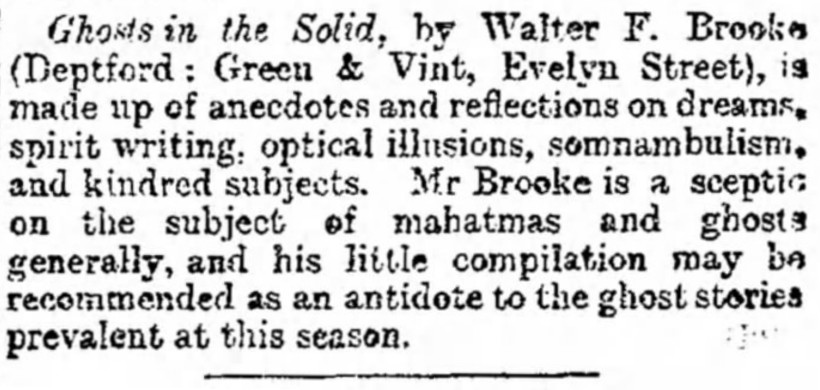
Not long after this interview, Brooke was sharing his not-a-ghost stories in pamphlet form. I haven’t found any of these texts available online, but one has the smirk-worthy title “Ghosts, Ghosts, Ghosts: Who, Why, When, Where, and What They Are.” Another is titled “Ghosts in the Solid,” and the National Library of Australia offers to make a digital copy of it. (Sadly, the cost is beyond of my budget. My birthday’s coming up, should anyone be feeling generous.)
“The Only One in the World”
In The Sign of Four (1890), Mr. Sherlock Holmes tells Dr. Watson: “I crave for mental exaltation. That is why I have chosen my own particular profession,—or rather created it, for I am the only one in the world.” The great detective quickly clarifies that he means the “only unofficial consulting detective.” By 1907, Brooke was given a dash of Holmes when an interviewer for The Daily Mirror described him as “a professional ghost-killer—the only one in the world.” The piece reveals that, while Brooke had left Messrs. Maskelyne & Cooke, he was still following in Holmes’s footsteps by probing mysteries and deducing their natural causes.
This interview illustrates how Brooke handles a specific case: an allegedly haunted house in Brighton. As the reporter accompanies his subject around the residence, dubbing him the “Bogey King,” they find that strange phenomena can be attributed to birds, floorboards, and the wind. And a nearby lunatic asylum. And railway tracks close enough that the whistles of passing trains and reflected light from fireboxes explain reports of sobbing and of a weird creature.
Along the way, Brooke shares a couple of anecdotes from earlier cases. He also says with a sigh:
If there is a ghost here I want to shake hands with it. I have been looking for a real, authentic spook for more than sixteen years. But I am afraid I shall never, never see one.
I’m not sure how much weight to grant this, but I find it interesting that Brooke’s main motive might not have been to disprove the reality of ghosts. Rather, he might have devoted a decade-and-a-half to paranormal investigation because he wanted the very opposite.
To Shake Hands with a Ghost
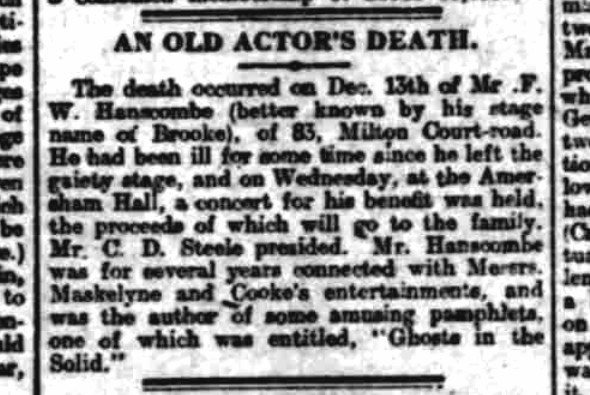
About three years after the Daily Mirror interview appeared, Brooke passed away. Back in 1899, an article had described him as “suffering from a severe throat trouble which incapacitates him from work” and announced “a benefit matinée” to support him financially. The importance of this didn’t click with me until I came upon Brooke’s 1909 obituary. There, I discovered that he “had been ill for some time” and another benefit had been arranged, this time to support those he left behind. I can’t be sure, but it’s possible Brooke was seriously ill for about the last ten years of his life.
Ghost hunting during the Victorian and Edwardian eras involved hours of waiting patiently, usually well into the night, for something to happen at a site reputed to be haunted. With this in mind, I can’t help but ask: since Brooke was ailing towards the end of his life, did he find these long evenings preferable to the physical demands of performing onstage? Furthermore, if he were contemplating his own death and the possibility of an afterlife, did that make him just a little more eager to shake hands with a ghost?
As with all of the inductees in the Hall of Fame, I find the lives of the ghost hunters at least as intriguing as what their investigations reveal about ghosts.